“Chess.com for math” is not a high-volume keyword yet. In the DataForSEO exact-match snapshot, the phrase itself did not show meaningful demand.
That does not make it useless. It is a good concept because people understand the shape immediately: daily puzzles, fair matches, progress, friends, rankings, and the feeling that practice is a game you return to.
The demand exists around nearby searches: “math games for adults,” “mental math games,” and “multiplayer math games.” Those are not the same phrase, but they point to the same gap. People want math practice that feels alive after school ends.
What Chess.com gets right as a model
Chess.com is not just a place to move pieces. Its public product surface points users toward live play, puzzles, lessons, bots, events, and a large community.
Math has usually been packaged differently. The default choices are lessons, worksheets, classroom platforms, or kid game worlds. Those can be good. But they often leave out the thing chess has normalized: practice as a public, repeatable game.
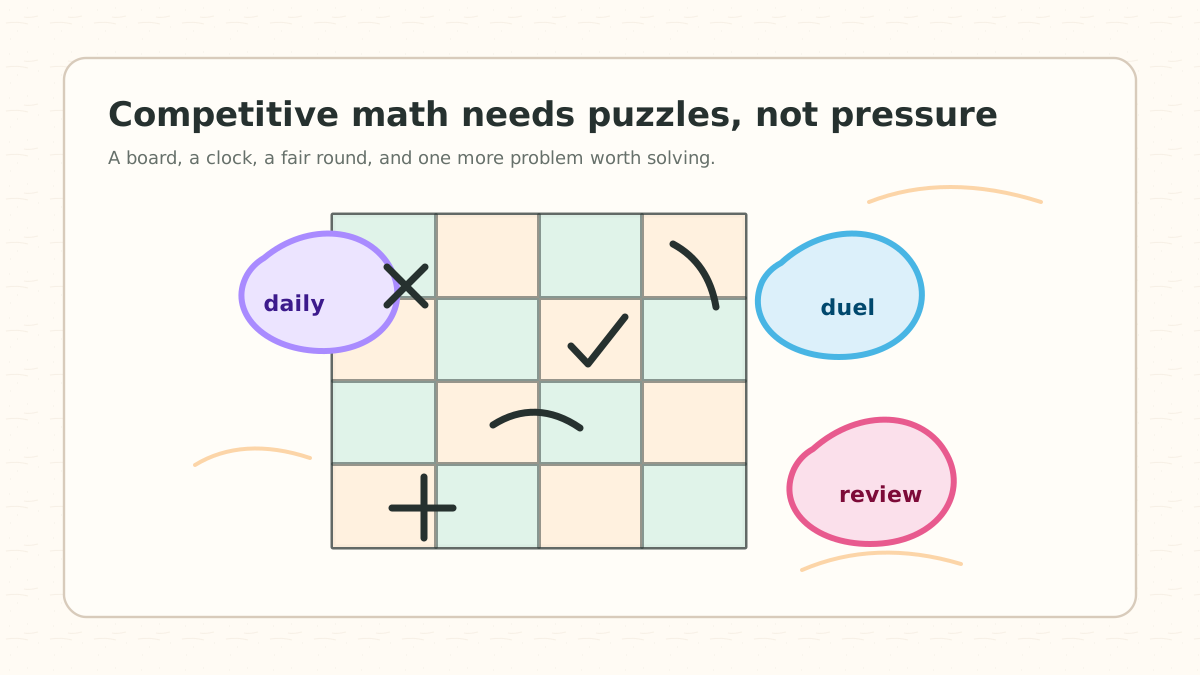
For math, that model would mean:
| Chess.com pattern | Math version |
|---|---|
| Daily puzzle | Daily math or pattern challenge |
| Live game | Live math duel |
| Puzzle rush | Timed fluency round |
| Lessons | Short explanations after mistakes |
| Rating or ranking | Skill-sensitive progress, not vanity points |
| Friends | Safe repeat matches and shared challenges |
What should not be copied
Math should not copy chess culture blindly.
Not every learner wants a rating. Not every child should be pushed into ranked competition. Math anxiety is real, and a leaderboard can make it worse if the app is careless.
A good competitive math product needs calm modes as well as duels. It needs practice history without shame. It needs a way to lose a round and still understand what improved.
That is why the best version is not “math esports for children.” It is a set of small, fair rounds that give the learner a reason to try again.
Competitive math should feel like a clean puzzle under a fair timer, not like a public exam.
Where Math & Patterns is already close
Math & Patterns is built around short games rather than long lessons. The app has twenty games. The web lets users play a smaller browser set immediately. The app adds live duels, daily challenge, rankings, and friends.
That makes it much closer to the “Chess.com for math” idea than a worksheet app.
The strongest current fit is mental math and pattern practice: quick addition, equation judgment, number ordering, symbol matching, memory, direction, logic, and speed rounds. It is meant for one more try, not a full class period.
Where Math & Patterns is not there yet
This is the honest part.
Chess.com has an enormous chess ecosystem. Math & Patterns does not have that scale. It does not yet have deep post-game analysis, large tournament culture, extensive lesson trees, or years of public community momentum.
It also is not a full curriculum. If you need a complete grade-level path, you should compare it with curriculum-first tools, not chess platforms.
The fair claim is narrower: Math & Patterns is building the competitive practice layer that most math apps do not make central.
Who should try it
Try Math & Patterns if you are a teen or adult who wants quick mental math instead of another casual phone game.
Try it if your child likes competition but gets bored by ordinary worksheet practice.
Try it if your family already uses a curriculum tool, but needs a more playful repetition layer.
Skip the competitive mode at first if the learner is anxious, brand new to the skill, or easily discouraged by losing. Start with solo rounds. Add duels later.
A Chess.com for math should make practice returnable. That is the benchmark.