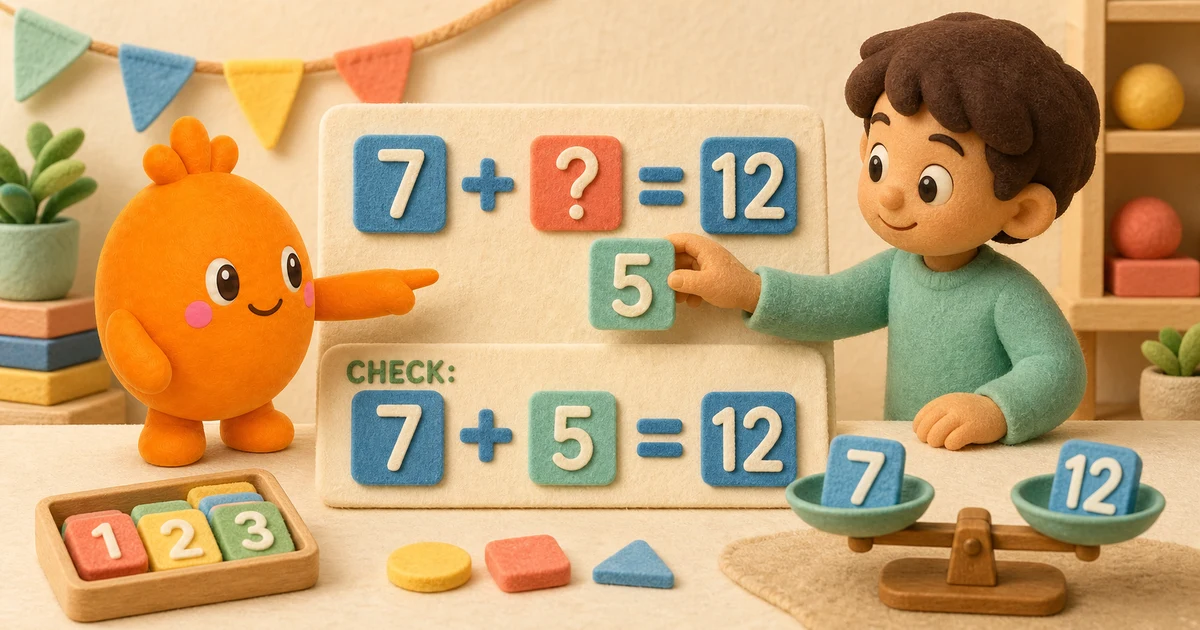
A blank is not an instruction to “do the opposite operation” immediately. Its position tells you what is missing.
Compare these two equations:
? − 7 = 512 − ? = 5
Both contain subtraction. The first blank is the starting whole, so 5 + 7 = 12. The second blank is the part removed, so 12 − 5 = 7.
The Department for Education mathematics guidance distinguishes finding an unknown whole with addition from finding an unknown part with subtraction. The same role-first habit works across all four operations.
The role-first decision table
| Equation shape | What is missing? | Calculation |
|---|---|---|
a + ? = c | an added part | c − a |
? + b = c | an added part | c − b |
a − ? = c | the removed part | a − c |
? − b = c | the starting whole | c + b |
a × ? = c | a factor | c ÷ a |
? × b = c | a factor | c ÷ b |
? ÷ b = c | the dividend | c × b |
a ÷ ? = c | the divisor | a ÷ c |
The letters are placeholders for known numbers. This table uses positive whole-number values, with exact division and no zero divisors. Zero cases need separate care: for example, 0 × ? = 0 does not have one unique answer.
Four worked examples
1. Missing added part
27 + ? = 45
The blank is one part of a total. Calculate 45 − 27 = 18.
Check by substitution: 27 + 18 = 45. Both sides agree.
2. Missing starting whole
? − 19 = 34
The blank is the number before 19 was removed. Calculate 34 + 19 = 53.
Check: 53 − 19 = 34.
3. Missing factor
8 × ? = 56
The blank is a factor. Calculate 56 ÷ 8 = 7.
Check: 8 × 7 = 56.
4. Missing divisor
72 ÷ ? = 9
The question is “72 split into how many equal groups gives 9 in each group?” Calculate 72 ÷ 9 = 8.
Check: 72 ÷ 8 = 9.
The missing-divisor form is easy to mishandle because division is not commutative. 72 ÷ 9 and 9 ÷ 72 are not interchangeable.
The substitution check
After every calculation, return to the original equation.
- Replace the blank with your answer.
- Evaluate the left side.
- Compare it with the right side.
This catches a surprisingly common error: using the correct pair of operations in the wrong order. If a learner solves 15 − ? = 6 as 15 + 6 = 21, substitution exposes it immediately because 15 − 21 is not 6.
An answer is not finished until it survives the original statement. This is the same equality idea developed in what the equals sign means: the expressions on both sides must have the same value.
A five-minute error-spotting round
Do not solve these from scratch first. Inspect the proposed answer and decide whether it fits.
| Original | Proposed answer | Verdict |
|---|---|---|
9 + ? = 16 | 7 | correct: 9 + 7 = 16 |
? − 8 = 11 | 3 | wrong: 3 − 8 ≠ 11; the answer is 19 |
6 × ? = 42 | 7 | correct: 6 × 7 = 42 |
48 ÷ ? = 6 | 288 | wrong: 48 ÷ 288 ≠ 6; the answer is 8 |
For two players, one writes an equation and a believable wrong answer. The other must disprove it by substitution, then repair it. Award one point for spotting the error and one for a valid check.
Online Math Learning’s missing-addend examples focus on addition. Use them if that is the only form causing trouble. Use the role table when the blank starts moving across operations.
Math & Patterns’ Fill the Blank uses addition, subtraction, multiplication and division with blanks in different positions and six answer choices. It is available for browser practice.
Sources and further reading
- The Department for Education’s mathematics guidance for key stages 1 and 2 develops part-whole and inverse-operation relationships.
- Missing Addends from Online Math Learning provides worked missing-addend examples and a playable practice format.