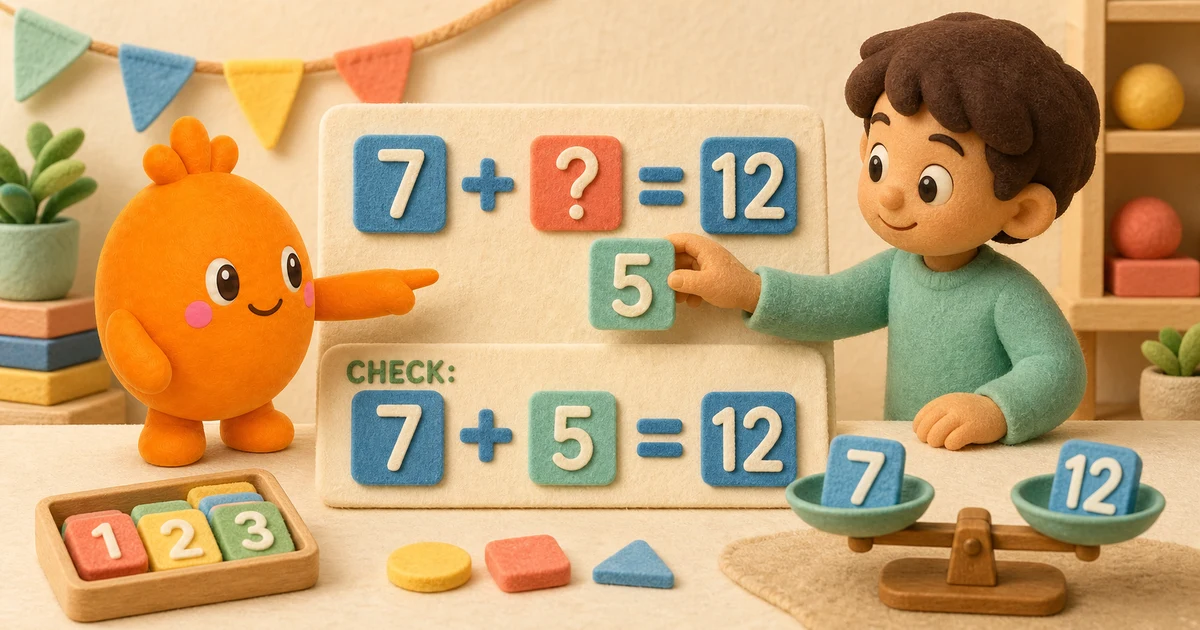
The equals sign is one of the most familiar symbols in mathematics and one of the easiest to misread.
It does not mean “now calculate” or “the answer comes next”. It means the expression on the left has the same value as the expression on the right.
Four true statements
Each of these is true:
- 8 + 4 = 12
- 12 = 8 + 4
- 8 + 4 = 6 + 6
- 15 = 15
The first form is common in worksheets, so it can train an operational habit: perform the calculation on the left and put an answer on the right. The other forms expose the deeper relationship. Equality has no preferred direction, and neither side has to be a single number.
Why unusual equation forms help
Try the statement:
7 + 5 = 7 + □
If the equals sign is read as “calculate now”, a learner may add 7 and 5 and write 12 in the box. If it is read relationally, the structure is clearer: both sides begin with 7, so the missing value must match 5.
Comparison-based instruction and exposure to non-standard equation forms have been studied as ways to strengthen understanding of equality. No single example guarantees later algebra success, but varied forms can reveal a misconception that ordinary answer-on-the-right exercises leave hidden.
Useful checks include:
- 9 = 9
- 10 = 4 + 6
- 3 + 8 = 5 + 6
- 14 − 2 = 7 + 5
- 6 + 4 = 6 + 3
The last statement is false because the two sides have different values. Its layout still makes sense; truth depends on equivalence, not on visual form.
The balance model
Imagine a level balance. If the left pan represents 8 + 4 and the right pan represents 12, the level beam shows that the totals match. Different arrangements can balance because equality concerns value, not appearance.
The model also explains why the same change must be made to both sides of an equation. If both sides of
x + 3 = 10
are reduced by 3, equality is preserved and the result is x = 7.
The analogy has limits. Mathematical expressions are not physical objects, and equal value is not the same thing as equal mass. Negative numbers, functions and symbolic identities can all be equal without a literal set of weights. Use the scale to make the relationship visible, then return to the mathematics.
Equality is symmetric and substitutable
Two properties make the meaning durable.
Symmetry: if a = b, then b = a. This is why 12 = 8 + 4 is valid.
Substitution: if two expressions are equal, one can replace the other in a suitable expression without changing the value. If a + b = 12, then an occurrence of a + b can be replaced by 12.
These ideas are the bridge from arithmetic equations to algebra. The equals sign keeps the same relational meaning even when numbers are replaced by variables or more complicated expressions.
A three-question equality check
For any equation, ask:
- What value does the left side have?
- What value does the right side have?
- Are those values the same?
This check works whether the equation is conventional, reversed, open or false. It also prevents a common order-of-operations mistake: simplifying one side carelessly and assuming the equals sign will repair it. For the evaluation rules themselves, see order of operations and left-to-right precedence.
Math & Patterns lists Balance Scale, where the game is described in terms of matching totals. Its page is an app-only next step rather than a claim that the analogy proves a learning outcome or that this entry is browser-playable.
Sources and further reading
- A study of textbook equation formats and equal-sign knowledge examines how presentation relates to relational understanding.
- A comparison-instruction study investigates learning from comparing equation forms.
- Annenberg Learner’s Equality and Balance develops the balance model for equations.
- A study of relational language and mathematical equivalence provides further context for how equality is discussed.