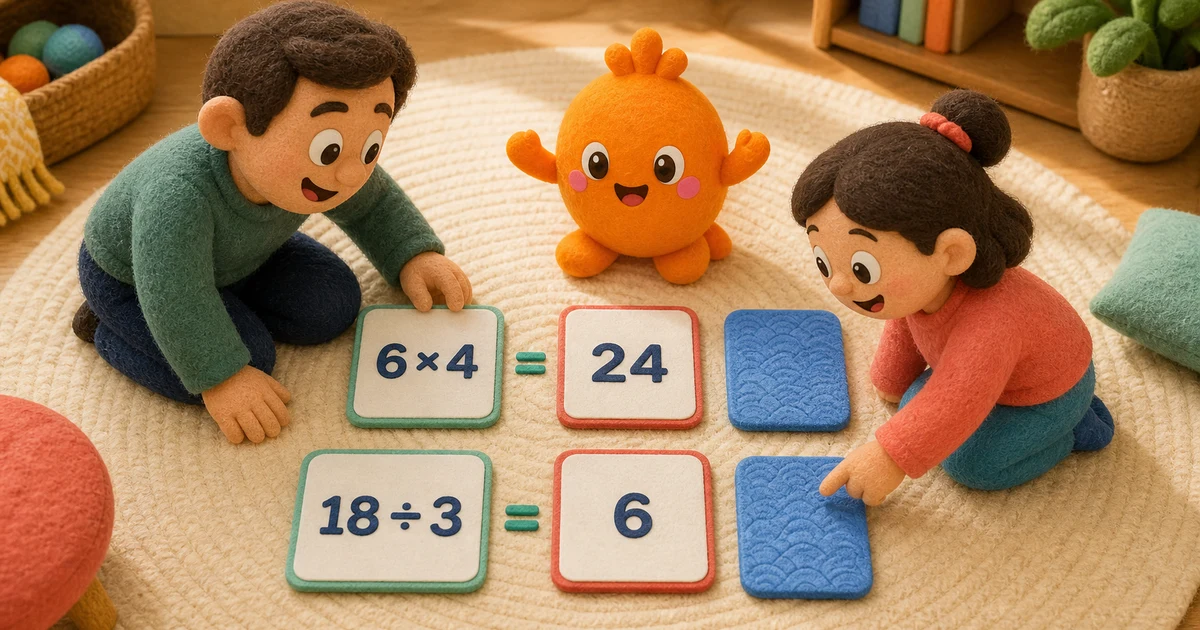
BODMAS and PEMDAS are memory aids, not six separate levels of precedence. Their compressed letters can create a predictable mistake: treating multiplication as always earlier than division, or addition as always earlier than subtraction.
The safer hierarchy has four levels:
- Grouping symbols such as parentheses.
- Exponents or orders.
- Multiplication and division, left to right.
- Addition and subtraction, left to right.
Multiplication and division share a level
Evaluate:
18 ÷ 3 × 2
Division and multiplication have equal precedence, so work left to right:
18 ÷ 3 × 2 = 6 × 2 = 12
Grouping 3 × 2 first would produce 3, but that grouping is not present in the written expression. If the intended denominator is 3 × 2, write it explicitly:
18 ÷ (3 × 2) = 3
The parentheses change the structure and therefore the value.
Addition and subtraction share a level
Evaluate:
20 − 6 + 2
Work left to right:
20 − 6 + 2 = 14 + 2 = 16
Adding 6 + 2 first would silently insert grouping that is not written. Again, parentheses make that alternative explicit:
20 − (6 + 2) = 12
Subtraction can also be understood as adding a negative, which leads to the same left-to-right result when signs are handled correctly.
Higher precedence still applies
For
3 + 4 × 5
the multiplication happens before the addition, giving 3 + 20 = 23.
For
(3 + 4) × 5
the parentheses come first, giving 7 × 5 = 35.
Left-to-right evaluation applies within one precedence level. It does not mean reading every expression as a simple queue from the first character to the last.
Why mnemonics cause arguments
PEMDAS groups multiplication with division and addition with subtraction, but the typography can disguise that pairing. BODMAS has the same issue: D and M are peers; A and S are peers.
A better spoken version is:
Grouping; powers; multiply or divide from left to right; add or subtract from left to right.
This wording contains the actual rule instead of relying on letter order.
Ambiguous notation should be rewritten
Some compact expressions mix division symbols, fraction-like groupings and implied multiplication in ways that invite different readings. Calculators and programming languages can also have different input conventions.
The productive response is not to declare that a viral puzzle has exposed universal mathematical failure. Rewrite the intended grouping with parentheses or a clear fraction bar. Mathematical communication should make structure visible.
A checking routine
Before calculating:
- Mark every explicit group.
- Simplify exponents inside the relevant groups.
- Scan left to right for multiplication or division at the current level.
- Scan left to right for addition or subtraction.
- Estimate the scale of the result and compare it with your exact answer.
The equals sign in each working line should mean “same value as”, not “and then I did this”. Read what the equals sign means for the relational model.
Math & Patterns’ browser-playable Number Order asks players to tap five integers in ascending order. It does not test expressions or order of operations; it is a separate number-comparison game for anyone who wants a short follow-on activity.
Sources and further reading
- A recent study of order-of-operations misconceptions examines how convention is understood and misapplied.
- A study involving prospective teachers documents persistent ambiguity and rule errors.
- The Australian Mathematical Sciences Institute’s whole-number arithmetic guide states the paired precedence convention.
- Hung-Hsi Wu’s note on order of operations explains why the convention should be connected to mathematical structure rather than memorised as a slogan.