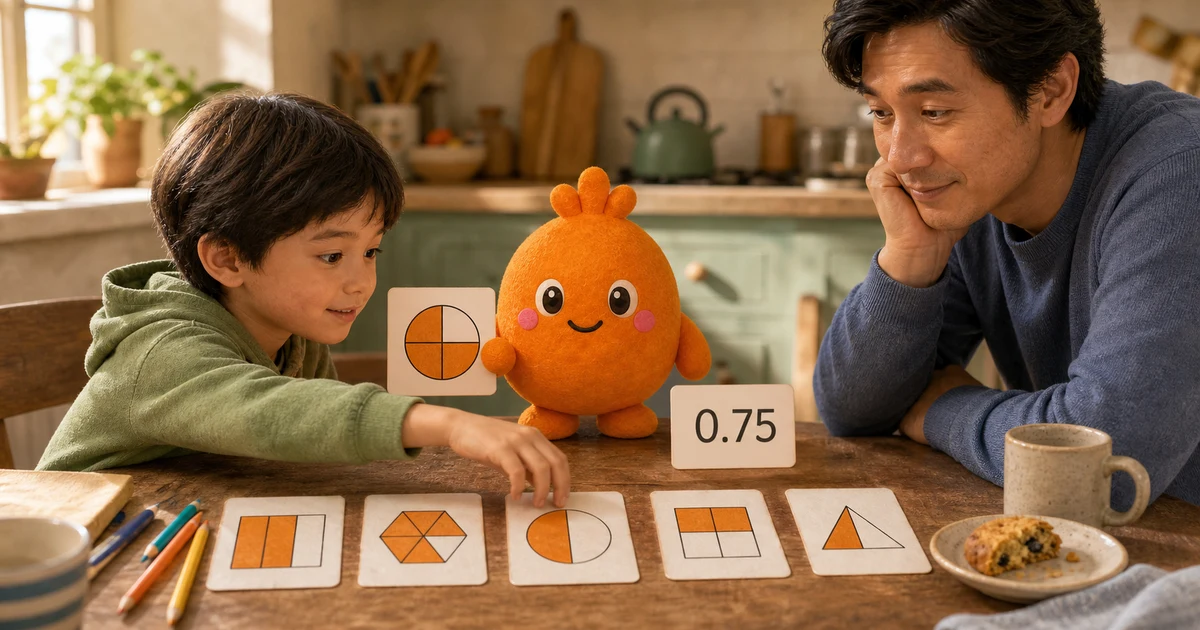
A matching game becomes much more useful when every pair has a reason.
The weak version is quick: turn two cards, hope they look familiar, keep them if they match. The stronger version adds one rule. Before a pair stays on the table, the player must convert one card and explain why the values are equal.
That separates the maths from the memory.
The national curriculum for mathematics in England connects fractions, decimals and percentages as different ways to express a proportion. The NRICH matching task offers printable sets and face-up or face-down play. Here is a small round you can make on scrap card.
If you want to begin without making cards, start a five-pair Connect Pairs round in the browser. The paper set below is an optional, slower version for talking through each conversion together.
Make these 12 cards
Write one value on each card:
| Fraction card | Matching card | Quick check |
|---|---|---|
| 1/2 | 0.5 | 1 divided by 2 is 0.5 |
| 1/4 | 25% | 25% means 25/100, which simplifies to 1/4 |
| 3/4 | 0.75 | 3 divided by 4 is 0.75 |
| 1/5 | 20% | 1/5 multiplied by 20/20 is 20/100 |
| 2/5 | 0.4 | 2 divided by 5 is 0.4 |
| 2/3 | 0.666… | The sixes continue |
Cut the table apart, shuffle the 12 cards and place every card face up.
Do not race yet. Work together and match the easy anchors first. Half is 0.5. A quarter is 25%. Three quarters is 75 hundredths, so it matches 0.75.
The last pair deserves care. Two thirds is not exactly 0.66. Dividing 2 by 3 produces a repeating decimal, written here as 0.666… . The dots matter.
Use one of three conversion checks
When a player proposes a match, ask for one check.
Divide. Turn a fraction into a decimal by dividing its numerator by its denominator. For 2/5, calculate 2 divided by 5 to get 0.4.
Use hundredths. A percentage names parts out of 100. Write 25% as 25/100, then simplify it to 1/4.
Scale a familiar fact. If 1/5 is 0.2, then 2/5 is twice as much, so it is 0.4.
The check should fit the numbers. Forcing every pair through the same method can hide a relationship that was already clear.
Play the memory round
Once all six face-up pairs have been explained, turn the cards face down in a four by three grid.
- Player A turns two cards.
- If they might match, Player A gives a conversion check.
- A correct pair stays face up and earns one point.
- A wrong pair turns face down again.
- Player B takes the next turn.
- Play ends when all six pairs are visible.
Memory helps you find a card again. Conversion decides whether the pair is true.
For a gentler round, leave the percentage cards face up. For a harder round, replace 1/2 and 0.5 with 5/8 and 0.625.
Try one deliberate trap
Add these two cards to the table:
- 2/3
- 0.66
They should not form a pair. Multiply 0.66 by 3 and you get 1.98, not 2. The difference is small, but the equality is still false.
A useful question is, “How could we write the decimal so the equality becomes exact?” The answer is 0.666… or recurring notation.
This kind of error card slows down visual guessing. It asks the player to defend the match.
Check the whole set
At the end, line up every pair and read the equations aloud:
- 1/2 = 0.5
- 1/4 = 25%
- 3/4 = 0.75
- 1/5 = 20%
- 2/5 = 0.4
- 2/3 = 0.666…
If one explanation feels shaky, keep that pair face up for the next game. The goal is not a perfect score. It is a set of equalities everyone at the table can check.
For a related card activity, try matching equations with their answers.
Math & Patterns’ Connect Pairs is available as browser practice. Its five-pair rounds match fractions or percentages with equivalent decimals. It is a focused matching mechanic, not proof that someone has mastered every fraction skill.