Ordering numbers is easier when you make one comparison at a time. Do not try to hold the entire row in your head.
Use this fixed routine:
- Compare the values using place value.
- Place the smallest remaining value into the next open position.
- Verify every neighbouring pair from left to right.
Here is a complete example.
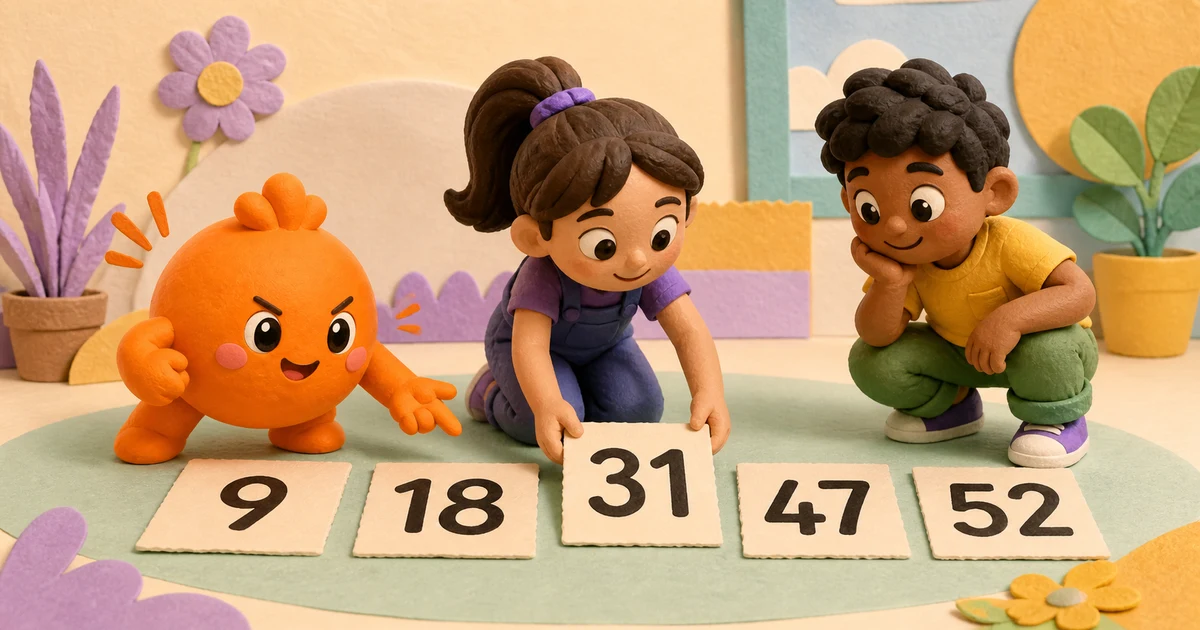
Order 47, 9, 31, 52 and 18
The set is:
47, 9, 31, 52, 18
First find the smallest. The number 9 has one digit; every other number has two. Among non-negative whole numbers written without leading zeroes, a one-digit number is smaller than a two-digit number. Put 9 first.
Now compare the tens digits of the remaining values:
- 18 has 1 ten.
- 31 has 3 tens.
- 47 has 4 tens.
- 52 has 5 tens.
Those tens digits already decide their order. The finished row is:
9, 18, 31, 47, 52
Do not stop after arranging the cards. Write the adjacent check:
9 < 18 < 31 < 47 < 52
Every comparison points in the same direction, so the order is verified.
When the tens digits match
Suppose you need to compare 43 and 47. Both have 4 tens, so the tens place cannot decide. Move one place to the right:
- 43 has 3 ones.
- 47 has 7 ones.
Because 3 is less than 7, 43 < 47.
The same idea extends to larger whole numbers. Compare the highest place first. Only move right when the digits match.
For example, compare 326 and 361:
- Hundreds: both have 3.
- Tens: 2 is less than 6.
- The ones digits are not needed.
Therefore 326 < 361.
Place one extreme at a time
With a longer set, repeatedly find the smallest unplaced number:
- Circle the smallest value.
- Move it into the next position on the left.
- Cross it out in the unsorted set.
- Repeat with what remains.
This reduces one large problem to several small comparisons. It also leaves a visible record, so a skipped number is easier to notice.
A number line can help when the symbols feel abstract: values farther left are smaller and values farther right are larger. But the place-value method is quicker when the numbers are not already plotted.
Three common errors
Comparing only the first digit. The 9 in 9 is greater than the 5 in 52, but 9 is still the smaller number because it has fewer place-value positions.
Sorting the digits inside a number. Ordering 47 and 52 does not mean rearranging them into 74 or 25. Each number stays intact.
Checking only the endpoints. A row can begin with the smallest and end with the largest while two middle values are reversed. Check every adjacent pair.
The method here stays with non-negative whole numbers, matching the narrow task demonstrated on this page. Ordering negative numbers, decimals or evaluated expressions needs extra comparison rules.
Try the exact browser task
Math & Patterns’ Number Order browser demo currently presents five integers and asks you to arrange them from smallest to largest. It does not demonstrate decimals, expressions or descending order, so this article does not claim those capabilities.
The game is a direct place to apply compare-place-verify. For a wider developmental overview, use the early maths skills by age guide. If the phrase “order” means which arithmetic operation to perform first, that is a different problem covered in order of operations: left to right.
Sources and further reading
- England’s primary mathematics national curriculum introduces the language of more, less, most and least in Year 1 and comparing and ordering numbers from 0 to 100 in Year 2.
- The Department for Education’s mathematics guidance for key stages 1 and 2 provides the place-value progression behind those comparisons.