Factors and multiples describe the same multiplication fact from opposite directions.
Take 3 × 4 = 12. Looking towards 12, both 3 and 4 are factors. Looking out from 3, 12 is a multiple. The vocabulary changes with the question you ask.
The Department for Education mathematics guidance includes finding factors and multiples of positive whole numbers. The quickest way to make the distinction usable is to attach a test to each word.
Two tests, no guesswork
For the positive whole numbers in this game, test whether a is a factor of n by calculating n ÷ a.
- Whole-number answer with no remainder: yes, a is a factor.
- Remainder or non-whole answer: no.
To test whether x is a multiple of n, ask whether n × a whole number = x. Exact division gives the same check: x ÷ n must be a whole number.
Try 4 and 18:
- Is 4 a factor of 18?
18 ÷ 4 = 4 remainder 2, so no. - Is 18 a multiple of 4? There is no whole number that makes
4 × ? = 18, so no.
Now try 6 and 18:
- Is 6 a factor of 18? Yes, because
18 ÷ 6 = 3. - Is 18 a multiple of 6? Yes, because
6 × 3 = 18.
Maths Is Fun’s factors and multiples guide gives more paired examples. The game below turns the definitions into decisions.
The four-way sorting game
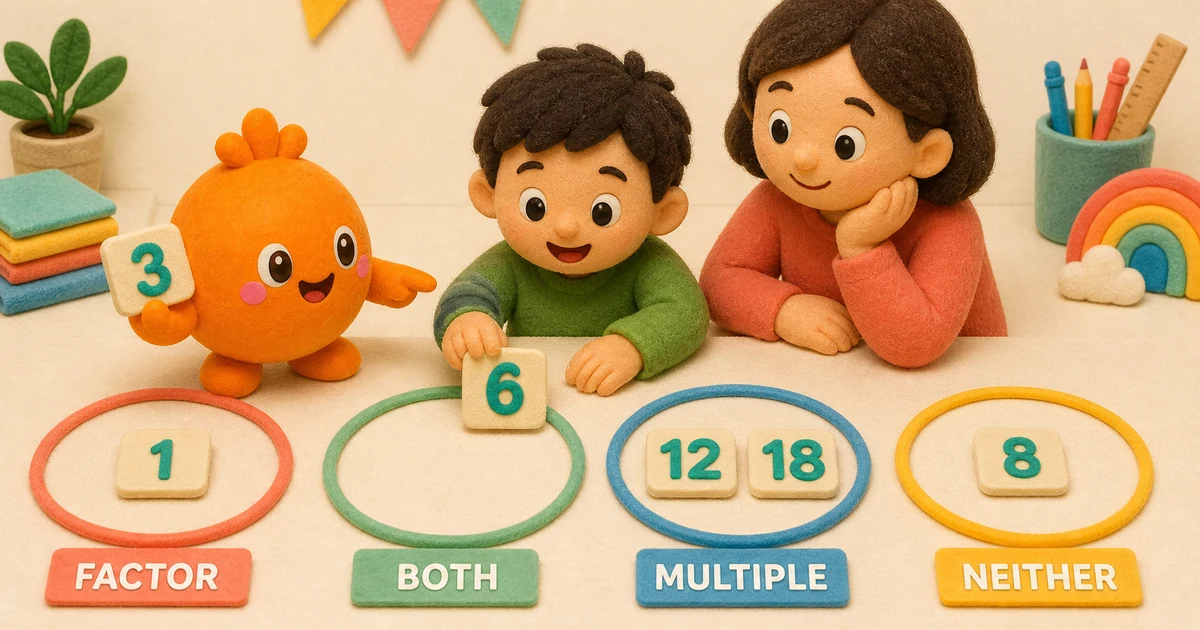
Write one base number at the top of a page. Under it, draw four boxes:
- Factor
- Multiple
- Both
- Neither
Start with base number 6 and these cards:
| Card | Test | Place it in |
|---|---|---|
| 1 | 6 ÷ 1 = 6 | Factor |
| 3 | 6 ÷ 3 = 2 | Factor |
| 6 | 6 ÷ 6 = 1 and 6 × 1 = 6 | Both |
| 8 | 8 neither divides 6 nor equals 6 × a whole number | Neither |
| 12 | 6 × 2 = 12 | Multiple |
| 18 | 6 × 3 = 18 | Multiple |
The card 6 is the useful trap. A positive whole number is a factor of itself and a multiple of itself. “Both” is not an empty box.
Play a 10-minute round
You need two players, scrap paper and a timer.
- Player A chooses a base number from 2 to 12.
- Player B writes six candidate cards. Include the base number, one factor, one multiple and one deliberate neither. Fill the last two freely.
- Player A sorts the cards and gives a multiplication or division reason for each one.
- Score one point for the correct box and one point for a correct equation. A right box with no explanation earns only one point.
- Swap roles after three minutes. Use the remaining time to challenge one decision each.
For base number 10, a strong set is 1, 4, 5, 10, 30, 45. The answers are factor, neither, factor, both, multiple, neither.
Do not make every card obvious. Cards near a familiar times table, such as 45 beside base 10, reveal whether the player is applying the exact rule.
Three common mix-ups
Listing only smaller numbers as factors. Most positive factors are smaller than the target, but the number itself is also a factor.
Stopping a list of multiples. You can stop writing, but the multiples do not stop. For 6 they continue 0, 6, 12, 18, 24... when zero and positive whole-number multipliers are allowed.
Treating “factor” as a property of one number alone. Say the whole relationship: “3 is a factor of 12.” The same 3 is not a factor of 10.
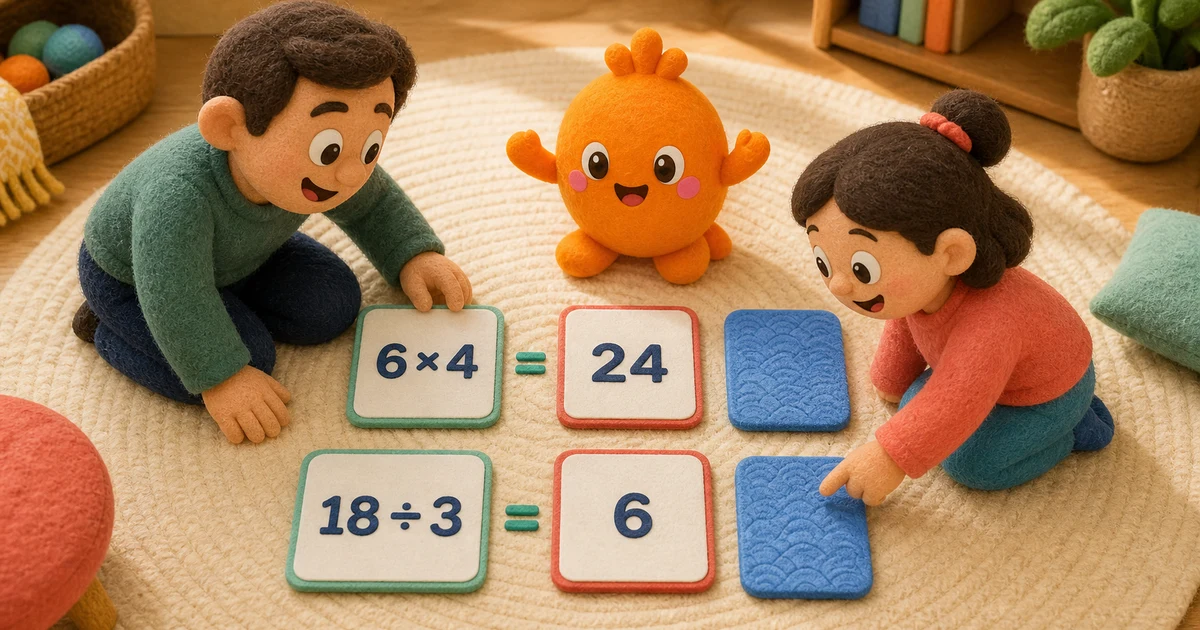
When the distinction is stable, multiplication facts become easier to read in both directions. For a different way to connect multiplication and division, try the equation and answer memory-match round.
Math & Patterns’ Bubble Pop is a separate mixed-arithmetic game with addition, subtraction and multiplication prompts. It is a lively next calculation round, not a factors-and-multiples mode.
Sources and further reading
- The Department for Education’s mathematics guidance for key stages 1 and 2 covers factors and multiples in primary mathematics.
- Factors and Multiples from Maths Is Fun provides definitions and examples.
- NRICH offers a longer Factors and Multiples game built around a shared number board.