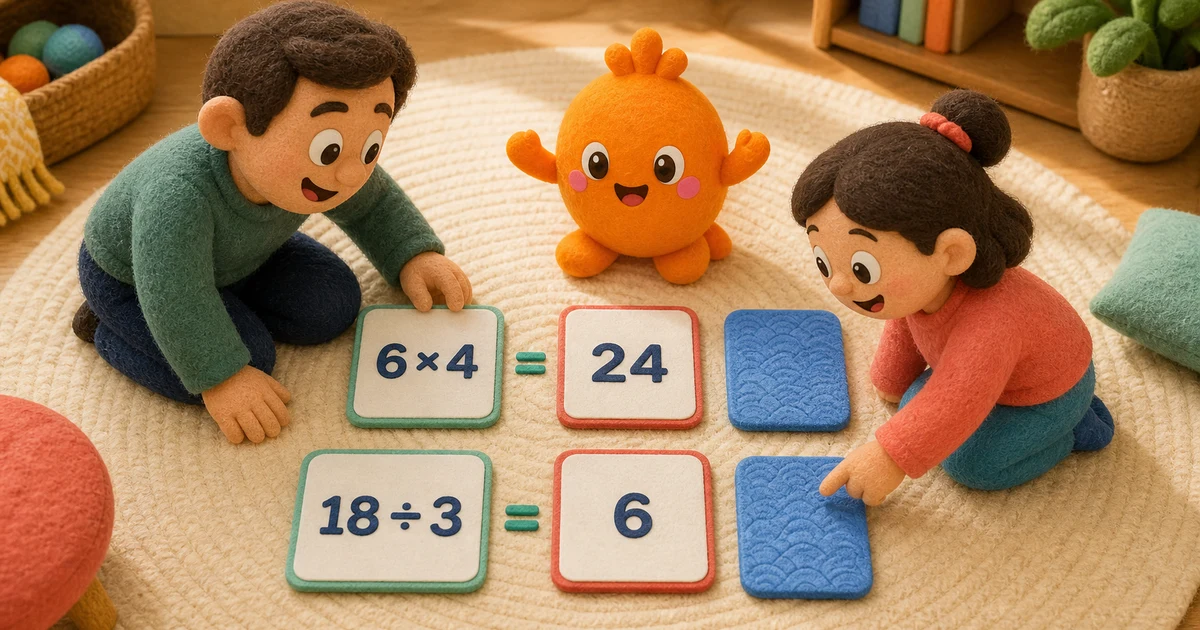
Ordinary concentration pairs identical pictures. Math memory match changes the pairing rule: one card shows an equation and the other shows the same value.
If you reveal 6 × 4, you are not hunting for another 6 × 4 card. You are hunting for 24.
That small change creates two distinct jobs:
- calculate the equation correctly;
- remember where its answer was revealed.
Keeping those jobs separate makes the round easier to learn from.
Build this six-card round
Cut six equal pieces of paper. Write one item on each:
| Position before shuffling | Card |
|---|---|
| A1 | 6 × 4 |
| A2 | 6 |
| A3 | 15 − 7 |
| B1 | 8 |
| B2 | 18 ÷ 3 |
| B3 | 24 |
The valid pairs are:
- A1 with B3 because
6 × 4 = 24 - A2 with B2 because
18 ÷ 3 = 6 - A3 with B1 because
15 − 7 = 8
Shuffle the cards before play, then place them face down in two rows of three. The A and B labels above only let us explain a worked round; players should not see them.
The practical rule matches current equation-answer formats such as Effortless Math’s Math Match: turn over an equation and a number, then decide whether their values match.
Say the value before searching
When you reveal an equation, calculate aloud before turning over the second card.
Suppose the first card is 15 − 7.
- Say “8”.
- Recall whether an 8 has appeared and where.
- Turn over one candidate card.
- Keep both only if the second card is 8.
This order prevents a hidden arithmetic error from masquerading as a memory error. If someone says 15 − 7 = 9, remembering the location of 9 perfectly will not make a valid pair.
For harder expressions, use the checking habits in how to estimate and check maths answers before blaming the card layout.
A worked three-turn example
Imagine the shuffled board contains:
| Left | Middle | Right |
|---|---|---|
24 | 18 ÷ 3 | 15 − 7 |
6 | 8 | 6 × 4 |
Turn 1: Reveal top middle, 18 ÷ 3, and say 6. Reveal bottom middle, 8. It is not a match. Turn both face down, but remember that 8 sits bottom middle.
Turn 2: Reveal top right, 15 − 7, and say 8. Recall bottom middle and reveal it. Keep the pair.
Turn 3: Reveal bottom right, 6 × 4, and say 24. Reveal top left and keep the pair.
The first mismatch still helped. It supplied a reliable location for the next equation.
Label the mistake, not the player
Use a tiny round log:
| What happened? | Mark |
|---|---|
| Equation value said incorrectly | calculation |
| Correct value, wrong card location | location |
| Both value and location were wrong | both |
| Valid pair found | match |
Do not convert this into a judgement about intelligence or memory in general. A location miss might follow a long interruption. A calculation miss might come from an operation sign read too quickly. The log describes the turn.
To adjust difficulty, change one thing at a time:
- Start with three pairs, then move to four.
- Keep answers distinct in early rounds.
- Use one operation first, then mix operations.
- Ask players to explain one match rather than racing every turn.
Math & Patterns’ Memory Match is available for browser practice and pairs equations with answers using addition, subtraction, multiplication and division under card-matching rules. Neither the paper round nor a game score proves broad memory or academic improvement.
Sources and further reading
- Effortless Math’s Math Match demonstrates the equation-and-number pairing convention.
- Math & Patterns’ current Memory Match catalogue page describes the app’s equation-answer matching mechanic.