Early math does not begin with a worksheet. It begins when a child notices two crackers, a bigger cup, a missing block, a round plate, a repeating song, or a line of toys that can be counted.
That is why age charts need care. They can help parents know what to look for, but they should not become pressure. Children grow unevenly. A child may be strong with shapes and still unsure about counting. Another may count loudly to twenty but skip objects when asked to count a real group.
Use ages as guideposts, not deadlines.
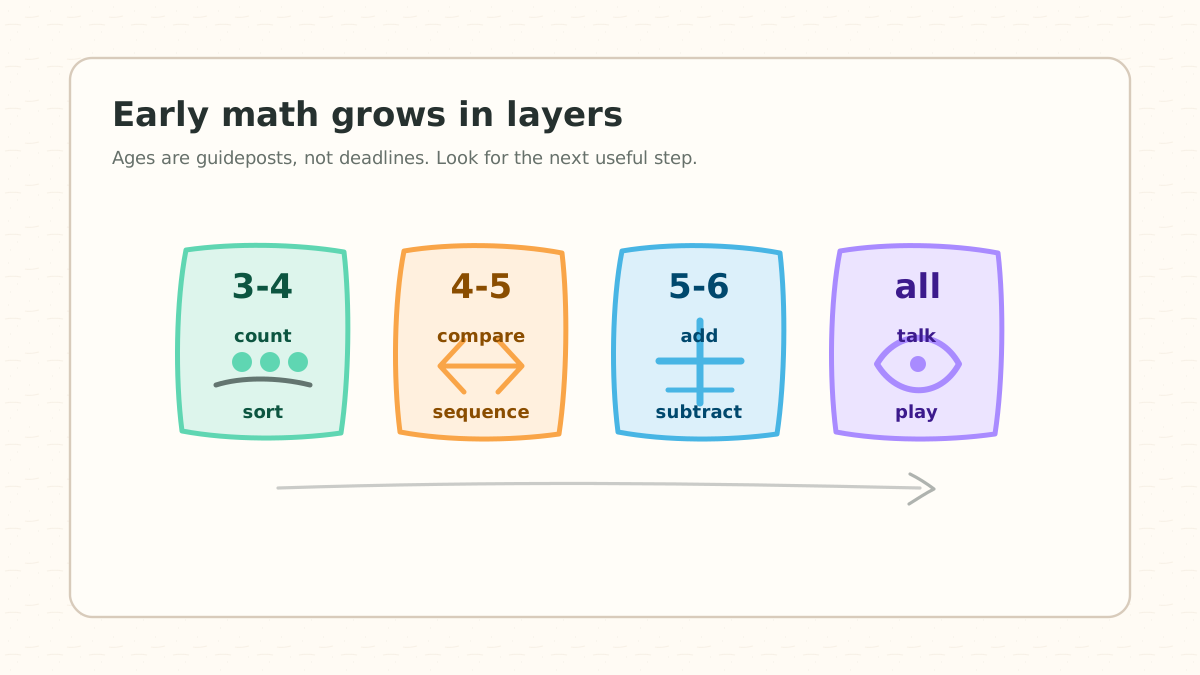
Ages 3 to 4: count, match, sort, notice
Many three- and four-year-olds are building early number sense through objects they can touch.
Useful skills include:
- counting small groups
- matching objects that are the same
- sorting by color, size, type, or shape
- comparing more and less
- recognizing simple shapes
- noticing simple patterns
The best home practice is concrete. Count berries. Sort socks. Compare two towers. Look for circles on plates and wheels. Make a red-blue-red-blue pattern with blocks.
At this age, do not worry if a child can recite number words faster than they can count objects accurately. Reciting and counting a real group are related, but they are not the same skill.
Ages 4 to 5: compare, sequence, describe
Around four and five, many children become more ready to compare and describe relationships.
Useful skills include:
- putting objects in order by size
- comparing which group has more or fewer
- recognizing numerals in everyday places
- continuing repeating patterns
- describing position words like above, below, beside, before, and after
- counting with better one-to-one tracking
This is a good age for parent questions:
- “How do you know this group has more?”
- “What comes next in the pattern?”
- “Which tower is taller?”
- “Can you put these from smallest to biggest?”
The explanation matters. A child who can say why is doing more than naming the answer.
If your child answers correctly, ask how they knew. If they answer incorrectly, ask them to show the count with objects. Both responses teach you what they understand.
Ages 5 to 6: combine, separate, solve
Many five- and six-year-olds are ready for early operations, but the work should still be concrete and visual.
Useful skills include:
- counting forward and backward
- recognizing numbers
- comparing quantities
- composing and decomposing small numbers
- simple addition with objects
- simple subtraction with objects
- solving short story problems
- explaining a strategy
For example:
“You have three blocks. I give you two more. How many now?”
“There are five grapes. You eat one. How many are left?”
“We need six plates. We have four. How many more do we need?”
These are real math problems because the child has to connect a story, a quantity, and an action.
What if my child is ahead or behind?
Do not panic from one chart.
Children develop at different speeds, and early math grows through repeated experiences. If your child is ahead, give them richer problems, not just faster drills. If your child is behind, return to objects, language, and smaller groups.
Watch for patterns:
- Does your child consistently skip objects while counting?
- Do they confuse number words and quantities?
- Do they avoid math because it feels stressful?
- Can they compare real groups?
- Can they explain what they did?
If you are worried, ask your child’s teacher or pediatrician what they are seeing too. A single hard day is not a diagnosis.
Everyday early math activities
You can practice early math without making it formal.
At breakfast: count berries, compare two piles, split crackers.
During laundry: sort socks, match pairs, compare sizes.
On a walk: find shapes, count steps, look for repeating patterns.
During cleanup: group toys by type, size, or color.
In the kitchen: measure, pour, compare full and empty.
With games: move one space at a time, count turns, compare numbers.
NAEYC family resources emphasize these everyday opportunities because they let children connect math words to real experiences.
How Math & Patterns can fit
Math & Patterns can support early math by giving children short digital practice loops: pattern games, number challenges, quick comparisons, and daily missions.
Use it as one part of the routine:
- Do one hands-on activity.
- Play one short game.
- Ask one explanation question.
- Stop.
That keeps the app connected to real thinking instead of becoming isolated screen time.
The parent takeaway
Early math is not a race to bigger numbers.
It is a slow build from objects, words, patterns, comparisons, and small problems. Help your child notice. Ask them to explain. Give them many short chances to try.
The strongest math habit at this age may be simple: “I can look carefully, think, and try again.”