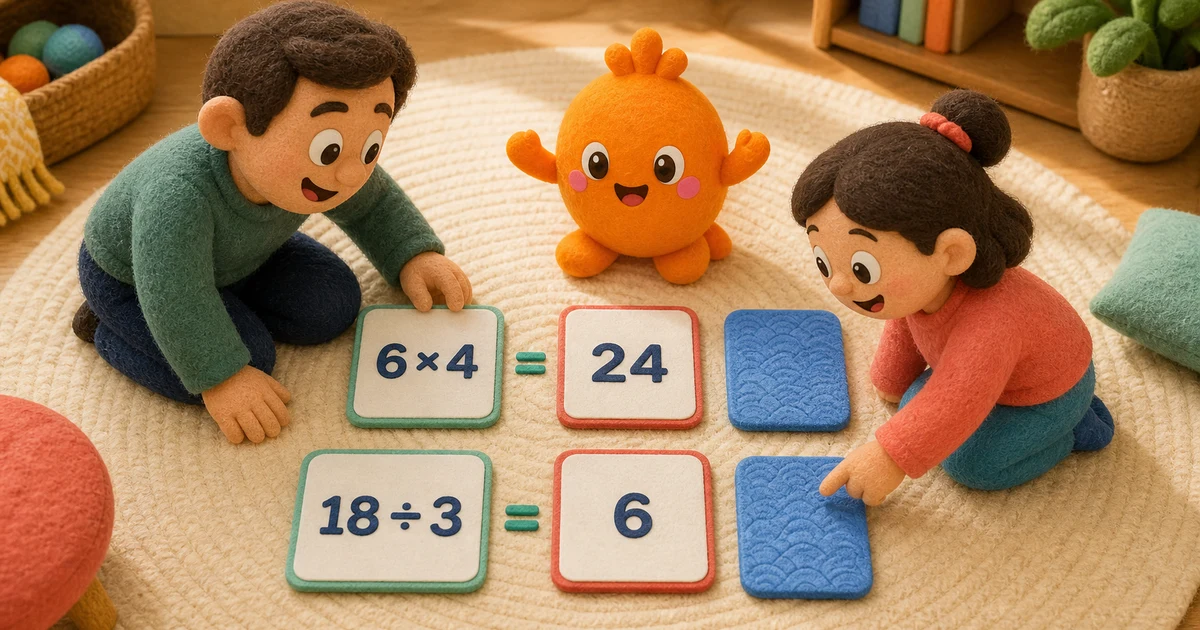
Multiplication is one of the biggest math-game search opportunities we found.
The DataForSEO pull was not subtle: “multiplication games” showed 60,500 average monthly US searches, and both “times tables games” and “multiplication table games” showed 40,500. That is much stronger than most comparison phrases.
But high volume is not enough. A page has to answer the parent question behind the search: which games actually help, and which ones only hide a worksheet inside a cartoon?
A good multiplication game shows the table
If a child is practicing 6 x 7, the game should not hide the math behind ten seconds of running, collecting, waiting, or tapping through rewards.
The product can still be fun. It can have a timer, color, sound, a route, a rival, or a score. But the multiplication fact has to stay central.
That is the parent test:
| If the game asks… | The child is practicing… |
|---|---|
| What is 8 x 6? | Recall |
| Which fact makes 42? | Inverse thinking |
| Which product is larger? | Comparison |
| What pattern do you notice in the 9s? | Structure |
| Can you answer accurately before the timer ends? | Fluency |
If the game mostly asks the child to steer a character, unlock costumes, or click through ads, the multiplication is decoration.
Speed is useful only after accuracy
Times tables are supposed to become quick. That does not mean every child should start with a speed test.
If a child is guessing, a timer trains them to guess faster. If a child already understands the fact family, a timer can make retrieval sharper.
So the order matters:
- Understand the groups.
- Notice the table pattern.
- Practice the fact.
- Add a little speed.
- Mix the facts.
Many multiplication games jump to step four because timers are easy to design. Parents should check whether the game also supports the earlier steps.
Accuracy first, speed second. A fast wrong answer is not fluency. It is just a mistake with confidence.
What the current SERP tells us
The DataForSEO organic snapshot for “multiplication games” was mostly game directories and practice tools. Multiplication.com, MultiplicationGames.com, and Timestables.com appeared near the top. Timestables.com also ranked first for “times tables games.”
That means searchers are often looking for something they can use immediately.
For Math & Patterns, the opportunity is not to pretend we are a giant multiplication directory. The stronger claim is narrower: if your child needs short phone-friendly practice, a one-minute math round can make arithmetic easier to start.
That is different from a dedicated times-table site. It is also useful.
When flashcards are still better
Flashcards are not outdated. They are blunt, but they work when the child needs direct retrieval practice and can stay calm long enough to do it.
Use flashcards when:
- the child knows the meaning of multiplication
- the target set is small
- the session is short
- mistakes get corrected immediately
- the child is not already upset
Use a multiplication game when the same facts need repetition but the child needs more movement, feedback, or choice.
The two tools can work together. A child can play one short game, then answer five cards, then stop.
What to avoid
Avoid multiplication games that reward guessing. If a child can tap random answers quickly and still feel successful, the score is not protecting the skill.
Avoid games where the math appears only every few minutes. That may be a fine game, but it is not a good multiplication practice session.
Avoid endless sessions. Multiplication fluency grows through repeat visits, not one long fight.
The best session is often small enough that the child would do it again tomorrow.
Where Math & Patterns fits
Math & Patterns is built around short games across arithmetic, logic, speed, geometry, and pattern recognition. It is round-first rather than worksheet-first.
That makes it useful for the start of practice.
If a child resists times tables, start with one quick arithmetic or number game. Then ask one question: “What helped you answer that?”
If they can explain a strategy, you have a bridge into the actual table work.
Math & Patterns should not be the only multiplication tool in the house. But it can be the tool that gets the child to begin.
A simple parent routine
Try this for one week:
- Pick one target table, such as 6s or 7s.
- Play one short math game.
- Ask the child to explain one answer.
- Do five table facts.
- Stop before the session turns sour.
The goal is not to make multiplication loud. The goal is to make the next repetition easier to start.