When people ask for a “Duolingo for math,” they are usually asking for three things at once.
They want the lesson to be small. They want progress to be visible. And they want math practice to stop feeling like a second homework pile.
That search is real. In the DataForSEO snapshot for this batch, “Duolingo Math” had meaningful demand, and related phrases included “Duolingo for math,” “Duolingo but for math,” and “is there a Duolingo for math.” The exact numbers are not huge compared with broad kid-math terms, but the intent is strong. These searchers already know what they want the experience to feel like.
The direct answer
Yes, Duolingo has a math course. Duolingo’s official math page describes bite-sized lessons, step-by-step help, and a standards-aligned course for elementary, middle, and high school students. It lists topics from arithmetic and geometry through algebra, statistics, calculus, and linear algebra.
So if your question is literal, the answer is yes: there is Duolingo Math.
But parents often mean a broader question: what would make math practice as easy to start as a language streak?
That is where the comparison gets useful.
What Duolingo-style math gets right
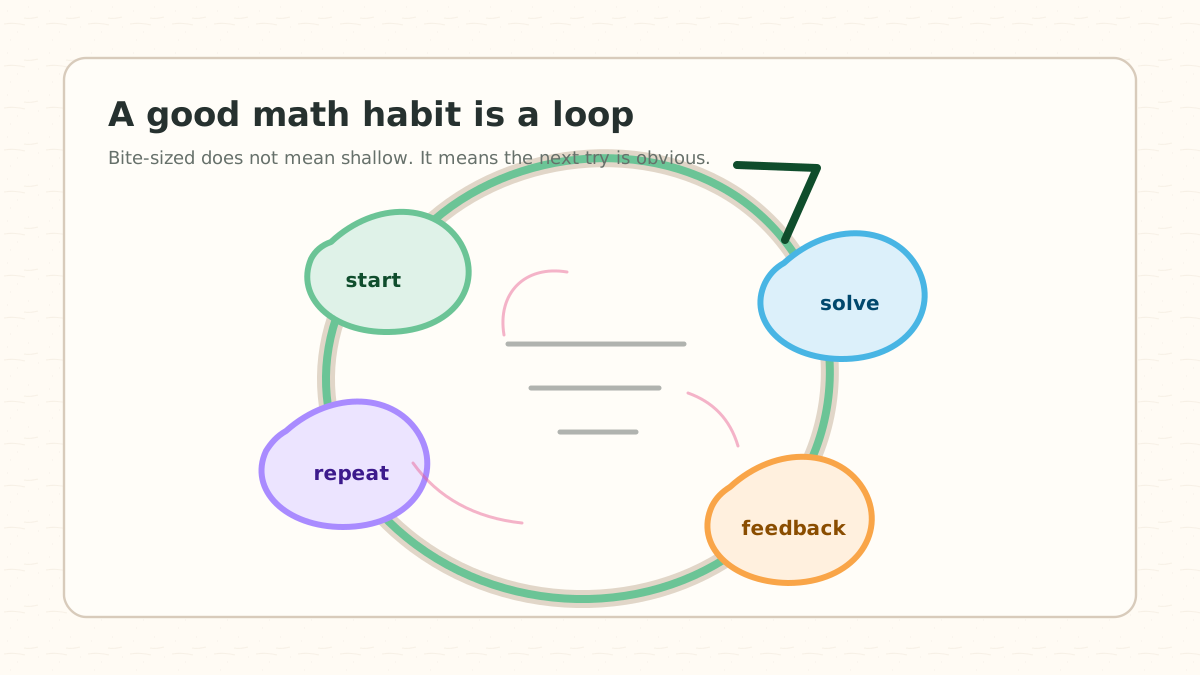
Small lessons matter. A child who will not sit for thirty minutes may still do three minutes. A teen who refuses another worksheet may still answer a few problems before a bus ride.
Visible progress matters too. Streaks, levels, and short completions help users feel that they are moving, not just being tested.
Feedback matters most. Math is unforgiving when a learner repeats the wrong method. A good app has to show what changed, what was right, and what to try next.
A Duolingo-style math app should not turn every problem into a tap-fast reflex. Math needs enough speed to build fluency, but enough thinking time to protect understanding.
What math needs that language apps do not
Math practice has a different failure mode. In language practice, a user can often recognize the right answer from context. In math, a user can get very good at guessing the shape of an answer without understanding the structure underneath.
That means a good math app needs variety. It needs number sense, visual patterns, timing, memory, ordering, logic, and correction. It should not be one infinite list of almost-identical questions.
It also needs the right kind of friction. Too much friction feels like school. Too little friction becomes a toy with arithmetic pasted on top.
Where Math & Patterns is different
Math & Patterns is not trying to be the official “Duolingo for math.” It is not a full course. It does not promise grade-by-grade coverage.
It is a short-round math game. The app has twenty games across arithmetic, algebra, geometry, logic, speed, and special categories. The browser lets users start with four games immediately, while the full app adds live duels, daily challenge, rankings, friends, and the rest of the game set.
The useful comparison is this:
| Need | Better fit |
|---|---|
| Standards-aligned guided lessons | Duolingo Math |
| Deep curriculum and school support | Prodigy, IXL, Khan Academy, Beast Academy |
| One fast round before dinner | Math & Patterns |
| Competing against a real person | Math & Patterns |
| Step-by-step course progression | Duolingo Math or a curriculum app |
| Habit-building without a long lesson | Either, depending on the child |
What a parent should choose
Choose a lesson app when the child needs instruction.
Choose a practice game when the child already knows enough to try and needs more repetition.
Choose a multiplayer math game when the child is bored by solo practice and responds to fair competition.
That is the honest difference. Duolingo Math is a strong answer to “teach me in small pieces.” Math & Patterns is an answer to “make me want one more round.”
Those are not the same problem. Many families will need both.