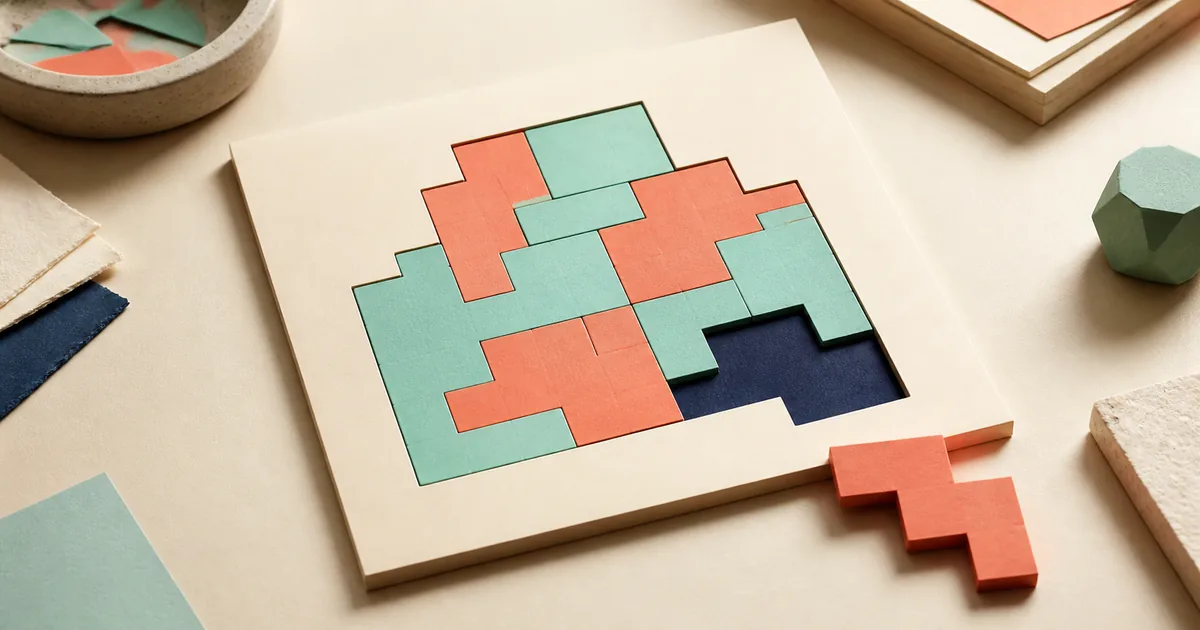
A full row disappearing feels like progress. Sometimes it is. Sometimes the satisfying clear makes the next piece impossible to place.
The useful pause is short: before committing a piece, read all the available shapes and find the hardest one to fit.
A Block Puzzle help page describes the common place-and-clear rule and the no-fit ending used by its game. Different block puzzles vary, so check the rules in front of you. The exercise below uses fixed pieces with no rotation.
What is a landing strip?
A landing strip is a straight open run reserved for a long piece.
If the available set contains a three-block horizontal bar, look for three adjacent empty cells. A scattered group of three empty cells is not enough. The cells must match the piece.
Keeping a landing strip does not guarantee success. It gives the awkward piece one known home while you decide what to do with the smaller pieces.
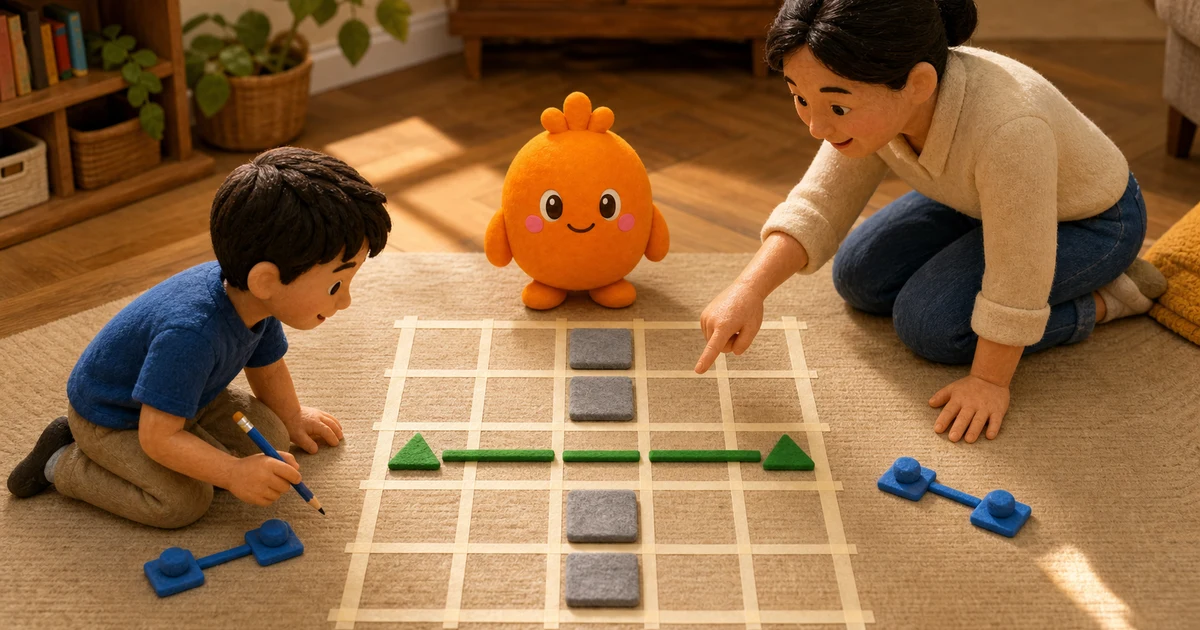
Copy the six by six board
Use # for a filled cell and . for an empty cell.
| Row | Board |
|---|---|
| 1 | ####.. |
| 2 | ###... |
| 3 | ##.... |
| 4 | ###... |
| 5 | #..... |
| 6 | ...... |
Your three fixed pieces are:
- A: a horizontal bar of length 3
- B: a horizontal bar of length 2
- C: a vertical bar of length 2
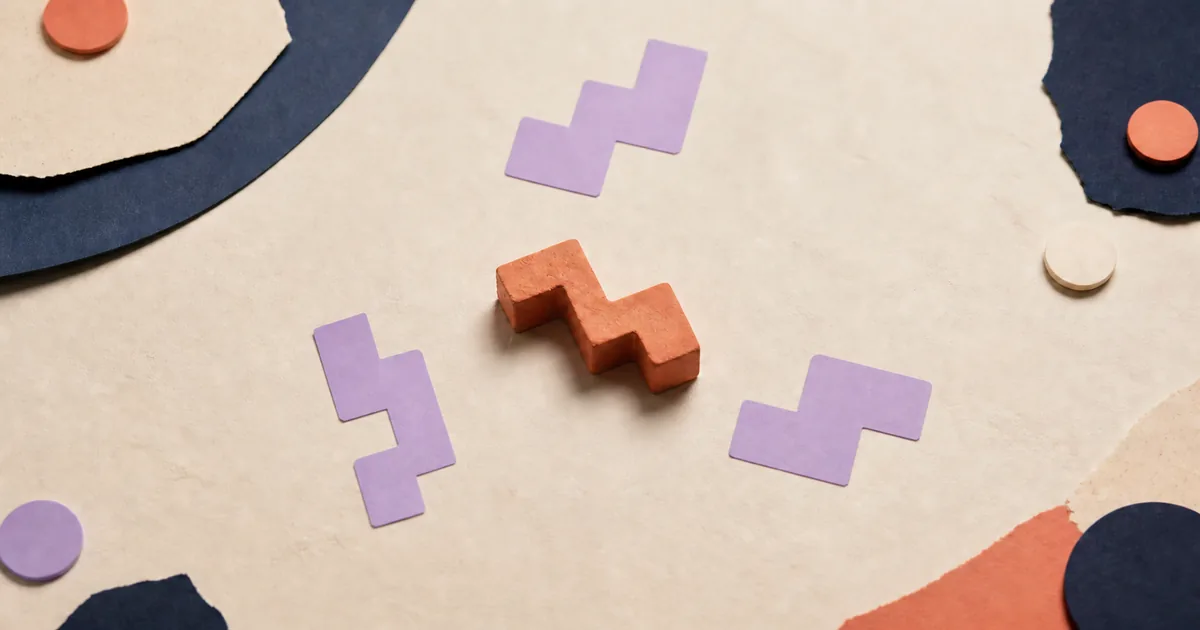
No piece may rotate. Place all three if you can. A complete row or column clears after placement.
Before touching the grid, point to every place where A fits. Row 1 cannot take it because only two cells are open. Rows 2 and 4 each have a three-cell run at columns 4 to 6. The lower rows have more options.
Now imagine placing B in row 2 at columns 4 and 5. That looks tidy, but it breaks row 2’s only exact three-cell strip. Piece A must go elsewhere.
A calmer choice is to keep row 2 columns 4 to 6 open for A and place B lower on the board.
Compare two legal plans
Plan one, take the tempting gap.
- Place B at r2c4 and r2c5.
- Row 2 now has one empty cell at c6.
- A no longer fits in that row.
- You still need to find A a home on rows 3, 4, 5 or 6.
This plan may still work. The point is that it spends one landing strip.
Plan two, reserve the strip.
- Place A at r2c4 through r2c6.
- Row 2 clears.
- Place B on row 5.
- Place C in a column where both cells are empty.
The clear creates a fresh six-cell row. It also removes the hardest piece first.
Plan two is not a universal answer. It is better for this set because A has fewer useful homes than B or C.
Ask the hardest-piece question
Before every placement, ask:
- Which current piece has the fewest legal homes?
- If I use one of those homes now, what remains?
- Will a line clear open space or split a clean lane into awkward holes?
This is the same kind of constraint reasoning used in polyomino puzzles, but the goal here is different. You are managing future placements while the board changes.
Make a two-player round
One player is the builder. The other is the checker.
The checker reveals three paper pieces. The builder has 20 seconds to name the hardest piece and mark one landing strip before placing anything.
After the move, the checker asks for one sentence: “I kept this lane because…” or “I spent this lane because the clear opens…”
Award a point for a legal placement and a second point for a correct look-ahead explanation. Do not award points for a claim that the move will definitely win.
Math & Patterns’ Linecraft is an app game with fixed pieces, full-row or full-column clears, line goals and move limits. Its canonical web page is an app handoff.