The most flexible-looking pair is often the wrong place to start.
In a path puzzle, an open pair can wander around the board. A pair trapped near a wall may have only one exit. Draw the wandering route first and it can steal that exit.
The Nikoli Numberlink rules give the core idea of connecting matching labels with continuous lines. The paper task here defines its own small board, blockers and exact-length clue.
Use the doorway test
A doorway is a cell that connects two larger areas of the grid.
Before drawing any line:
- Circle every one-cell doorway.
- Ask which endpoint pairs might need it.
- Reserve it for the pair with no reasonable alternative.
- Route flexible pairs around the reserved corridor.
This is a constraint check, not a guarantee. You may still need to redraw.
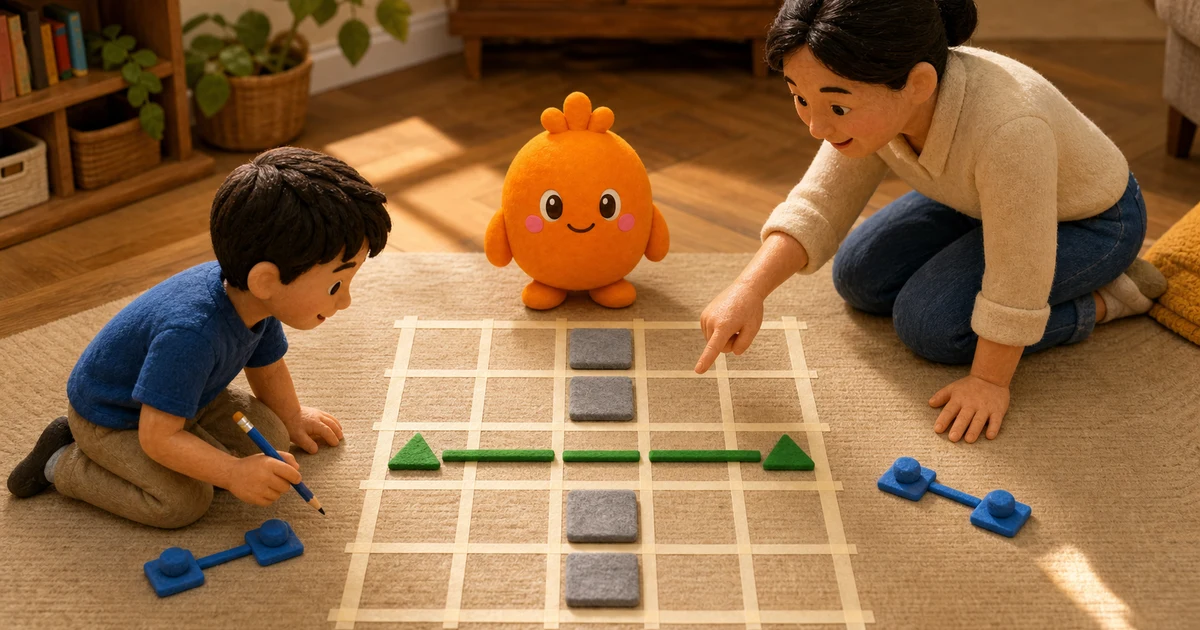
Copy this five by five grid
Use rows 1 to 5 from top to bottom and columns 1 to 5 from left to right.
Place blockers at r1c3, r2c3, r4c3 and r5c3. They form a vertical wall with one open doorway at r3c3.
Place the endpoints:
- A at r1c1 and r2c2
- B at r4c4 and r5c5
- C at r3c1 and r3c5
Give pair C an exact length of 5.
For this activity, length means the number of squares visited, including both endpoint squares. That convention belongs to this paper puzzle. Another puzzle may count edges instead.
Try to connect each matching pair. Routes may move up, down, left or right. They may not cross, share a square or enter the blocked cell.
Send C through the doorway first
Pair C is the only pair with endpoints on opposite sides of the wall. It must use r3c3. A five-square route is:
r3c1, r3c2, r3c3, r3c4, r3c5
Count the squares. There are five, including both endpoint squares. The middle square is the only doorway.
Now connect A on the left:
r1c1, r1c2, r2c2
Connect B on the right:
r4c4, r5c4, r5c5
The three routes do not cross or share a square.
If A or B uses the doorway first, C cannot cross the wall. The early line can look harmless and still make the required route impossible.
Make the puzzle harder
Move C’s right endpoint from r3c5 to r2c5 and change its clue to 6. Keep the same four blockers.
Do not draw immediately. Mark the cells around r4c4 and ask:
- Which pair still needs the only doorway?
- Can C reach its moved endpoint in exactly six squares?
- Which three-square routes leave the doorway free for C?
If the answer is unclear, use dotted candidate routes before choosing one. A faint plan is easier to erase than a thick committed line.
Three checks at the end
A finished drawing needs more than a tidy appearance.
Pair check. Every route joins matching endpoints.
Collision check. No two routes share a square or cross.
Length check. Count the marked route using the stated convention. For C in the starter grid, the route crosses the doorway and visits five squares.
This activity leaves unused squares because that is one of its stated rules. If you play a different puzzle, follow the rules printed with that puzzle.
For another route-planning idea, read shortest-route puzzle strategies. That article asks a different question about comparing route lengths rather than connecting several pairs.
Math & Patterns’ Flow Codes is an app game with matching endpoints, non-crossing routes and later exact-length clues and blocked cells. Its web page currently hands off to the app.