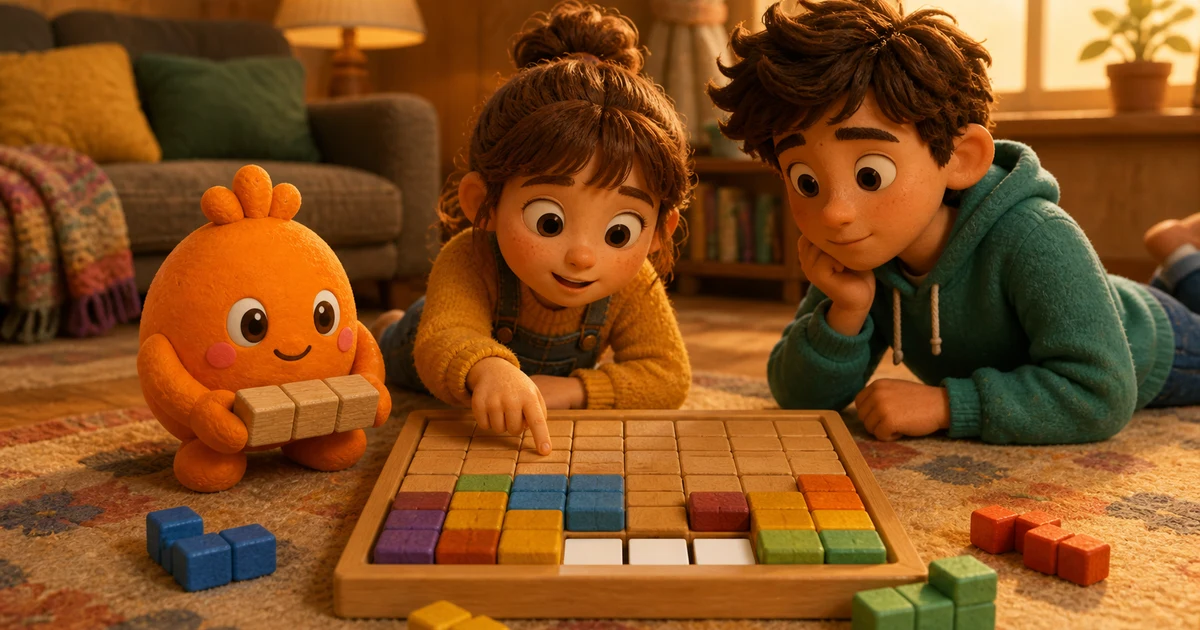
A polyomino is built from equal squares joined edge-to-edge. The name tells you the number of squares: dominoes use two, trominoes three, tetrominoes four and pentominoes five.
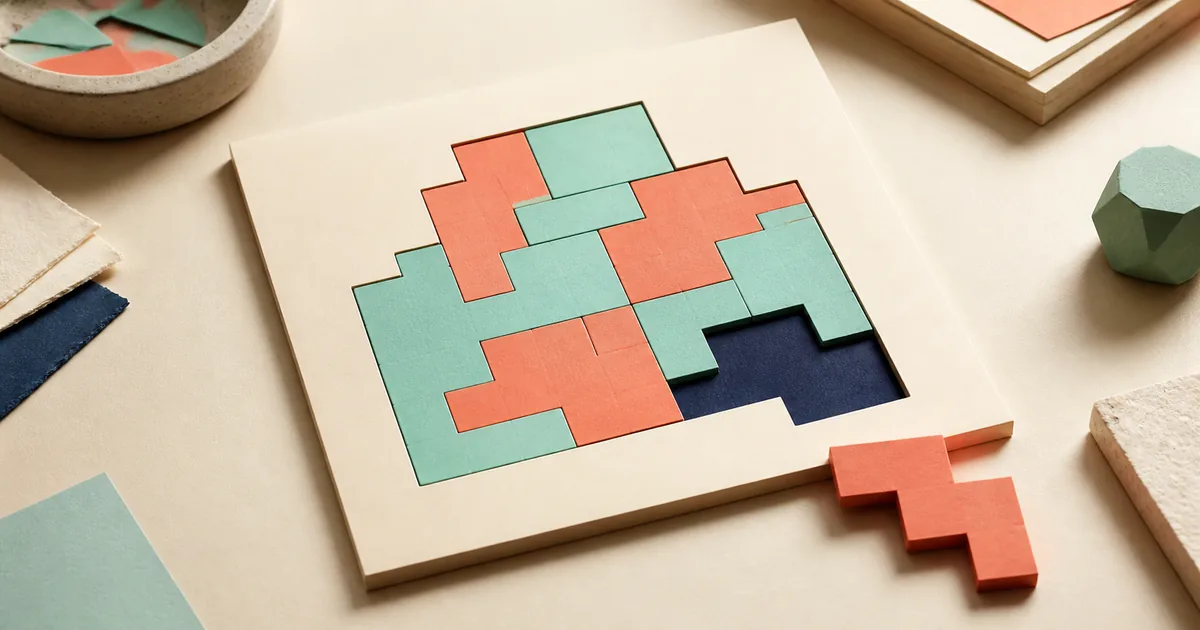
Packing puzzles ask you to cover a target with specified pieces, usually without gaps or overlaps. They look like free-form spatial play, but the fastest progress often comes from bookkeeping and constraints.
First check: does the area match?
Count the unit squares in every piece and add them. Then count the unit cells in the target.
If six pentominoes must fill a target, their total area is 6 × 5 = 30 unit squares. A 29-cell or 31-cell target cannot be tiled by all six without changing the rules.
Matching area is necessary, not sufficient. Pieces can have the right total area and still fail because their shapes cannot cover a narrow region or because every arrangement leaves an isolated hole.
Find constrained cells before easy space
Large open areas accept many pieces. Tight corners, one-cell necks and jagged edges accept few.
Scan the outline and ask:
- Which cell can be covered by the fewest pieces?
- Which corner requires a piece to approach from only one direction?
- Could a placement create an isolated pocket smaller than every remaining piece?
- Will a narrow corridor still be reachable after this move?
Starting with these questions reduces the search. Filling the easy centre first can leave a beautiful partial board that has no legal ending.
Place awkward pieces, not automatically large ones
“Largest first” is common advice, but polyominoes in the same puzzle often have equal area. Even when sizes differ, the relevant property is how many valid placements a piece has.
An asymmetric piece with one deep notch may be harder to place than a larger rectangle. A symmetric piece may fit in many orientations and can wait. Choose the piece or cell with the fewest plausible options, and be willing to revise that judgement as the board changes.
Use colouring as a falsifier
Colour the target like a chessboard. Some pieces cover fixed or limited combinations of light and dark cells in each orientation. If the remaining target contains a colour imbalance that the remaining pieces cannot match, the current branch is impossible.
This is a way to rule out arrangements, not a universal solution. Passing a colouring test does not guarantee that the pieces will fit. Other colourings, parity checks or boundary arguments may reveal constraints that a simple checkerboard misses.
The useful habit is to ask what must remain true after a placement.
Backtrack deliberately
Backtracking means making a choice, following its consequences, and undoing it when a contradiction appears.
Use a small decision log:
- Choose the most constrained cell.
- List the pieces and orientations that could cover it.
- Try one placement.
- Check for isolated cells, area mismatch or impossible remaining shapes.
- If blocked, undo to the last genuine choice and try the next option.
Do not restart the whole puzzle after every dead end. A dead end contains information: at least one earlier choice was incompatible with completion.
Computer solvers formalise this process through search and, for many tiling problems, exact-cover formulations. Human solvers can borrow the same discipline without enumerating every branch.
Rotation is only one part of fitting
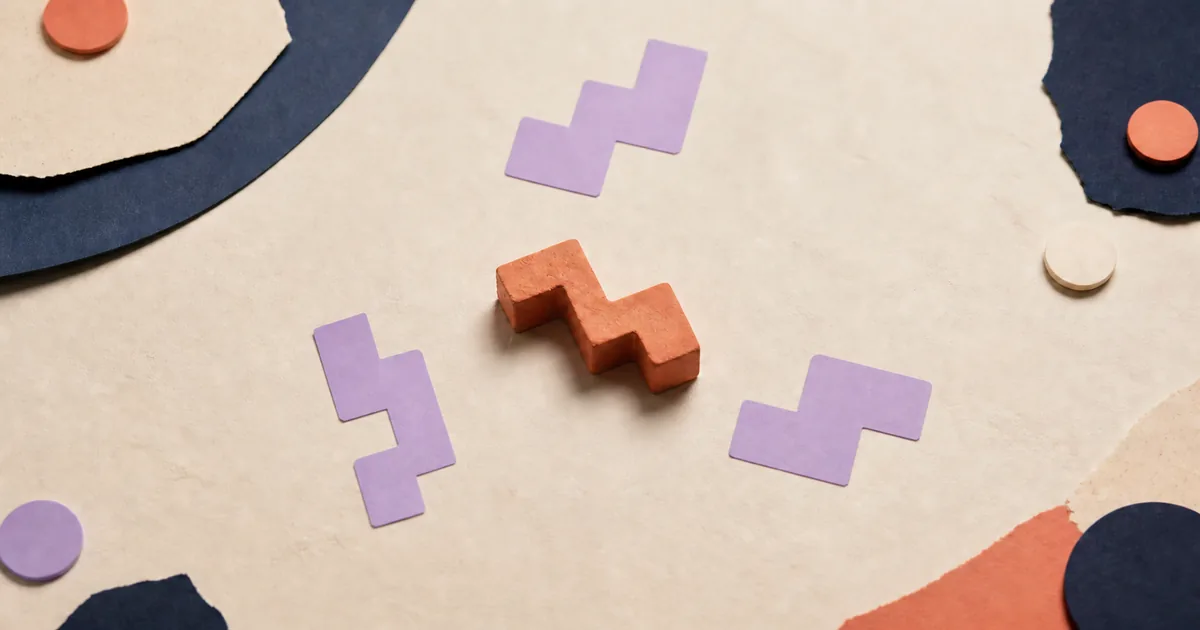
You may need to imagine how a piece looks after turning, but orientation is not the whole problem. A rotated piece can match one corner and still block the remaining board.
Use the mental-rotation anchor method to compare orientations, then return to the global constraints: area, coverage, adjacency and the shapes still in the tray.
Math & Patterns lists Mosaic Fit, described as filling a target outline with pieces. Its page is an app-only next step; this article does not claim that the entry is a current browser demo or that any tactic guarantees an optimum solve.
Sources and further reading
- Carnegie Mellon University’s polyomino notes define the objects and develop tiling questions.
- The Hobart and William Smith Colleges pentomino solver notes explain a backtracking search.
- A current shape-fitting guide was reviewed for live puzzle conventions and common tactics.
- This pentomino and exact-cover reference connects tiling problems with systematic search.