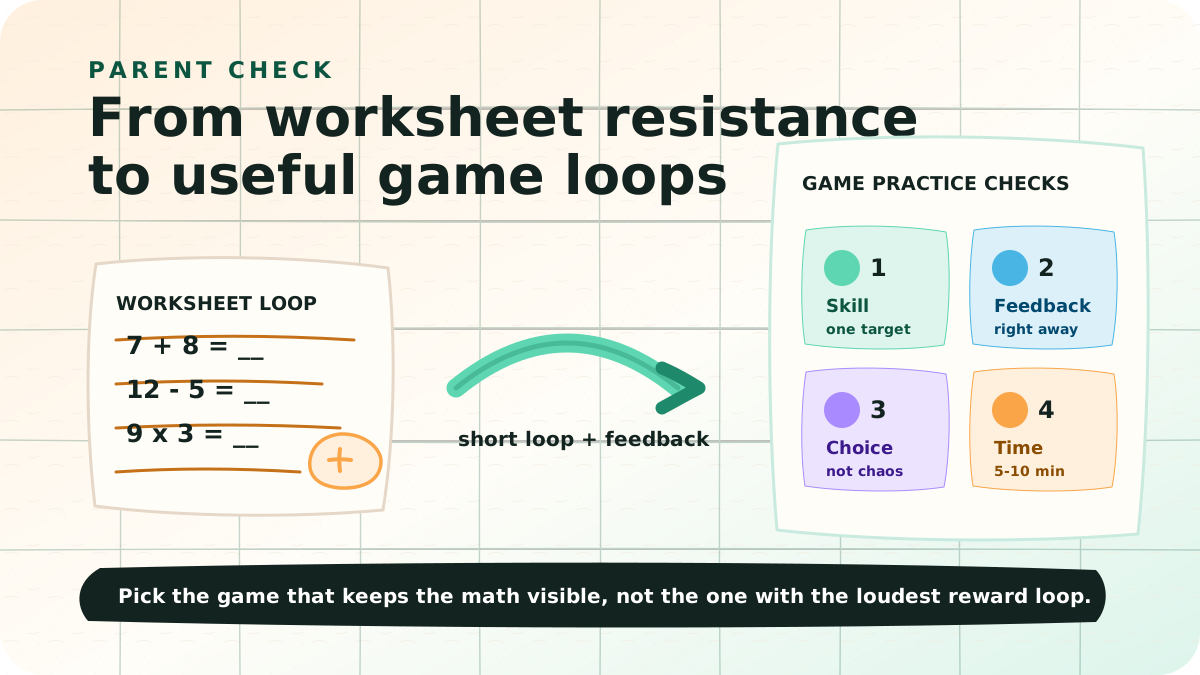
If your child hates worksheets, the problem may not be math itself. It may be the shape of the practice: a full page, no choice, delayed feedback, and no clear finish line.
A good math game changes that shape. It gives the child a small decision, a visible challenge, quick feedback, and a reason to try one more round. That does not make every game educational. It just means the right game can get a child to practice when a worksheet cannot even get started.
The list below is not a universal ranking. It is a parent decision guide. The best pick depends on whether your child needs early number sense, a story world, curriculum coverage, targeted repetition, deeper problem solving, or a fast pattern game.
What to look for before you choose
Before picking a math game, ask four questions.
First, what skill is the game actually practicing? “Math” is too broad. A useful game should make it possible to say, “This works on number sense,” “This works on multiplication facts,” or “This works on pattern recognition.”
Second, does the child get feedback quickly? If a child answers five questions incorrectly before the game explains anything, the game may keep them busy without helping them correct course.
Third, is there enough choice to feel playful without hiding the work? Exploration, characters, quests, and rewards can help. But if the game becomes mostly collecting, decorating, or waiting through animations, the math can disappear.
Fourth, does the session have a natural stop? Worksheet-resistant children often do better with five to ten useful minutes than with a long session that ends in a fight.
Choose the game your child will actually start, but keep the standard high: the math should still be visible, specific, and repeated enough to matter.
Quick comparison
| Tool | Best fit | Watch out for |
|---|---|---|
| Khan Academy Kids | Free early math, ages 2-8, counting, shapes, addition, and problem solving | Older children may outgrow the early-learning feel |
| Prodigy | Children who like RPG worlds, quests, battles, and grade 1-8 practice | The game world can become the main attraction |
| SplashLearn | Parents who want broad PreK-grade 5 curriculum coverage in math and English | Breadth can feel like a lot if you only want one quick daily game |
| IXL | Targeted practice, diagnostics, and skill-by-skill repetition | Some children may experience it as practice first, game second |
| Beast Academy | Strong elementary problem-solvers who like challenge and depth | It may be too demanding as the first step for a child who already resists math |
| Math & Patterns | Short pattern-first games, daily challenge, and quick practice loops | It is not a full curriculum replacement |
1. Khan Academy Kids: best free start for early learners
Khan Academy Kids is the easiest first recommendation when the child is young and the parent wants something free. Its official math page frames the app around ages 2-8, early number sense, counting, shapes, addition, subtraction, problem solving, and playful feedback.
That makes it a strong fit for preschool, kindergarten, first grade, and second grade children who need math to feel gentle and confidence-building. It is also useful when a parent is trying to avoid ads or subscription pressure.
Choose Khan Academy Kids if your child is still building early foundations, likes friendly characters, and needs a low-friction start. Do not choose it because you need a full upper-elementary math challenge. That is not where it is strongest.
2. Prodigy: best for children who need a story world
Prodigy is one of the best-known game-based math options. Its official page describes an adventure-style experience where students answer questions to move forward, with Prodigy Math aimed mainly at grades 1-8 and built around curriculum-aligned practice.
That matters for worksheet-resistant children because some children need the fiction first. They will practice more willingly if the math is part of a battle, quest, pet, spell, or world.
Choose Prodigy if your child likes RPGs and needs a bigger motivational wrapper around practice. Keep an eye on whether they are doing the math or mostly chasing the game layer. A simple parent check is to ask, “What kind of problem did you solve today?” If they can answer, the math is still visible.
3. SplashLearn: best for broad curriculum coverage
SplashLearn is built around math and English for preschool through grade 5, with games and worksheets across many topics. That makes it more of a curriculum library than a single math toy.
This is helpful when you want a large menu and are not sure which specific skill your child needs next. It can also work for families who want math and English under one roof.
Choose SplashLearn if you want breadth, grade-level pathways, and lots of practice options. If your child is overwhelmed by too many choices, start with one topic only. Do not hand them the whole library and hope motivation appears.
4. IXL: best for targeted practice
IXL is positioned around personalized learning, with coverage across math, language arts, science, social studies, Spanish, and PreK-12. Its strength is not that it feels like a video game. Its strength is structured, targeted practice.
That can be exactly what a parent needs when a child has one clear gap: fractions, multiplication facts, place value, word problems, or another skill that needs repetition.
Choose IXL if you want skill-by-skill practice and progress visibility. Be careful with a child who already equates math with pressure. For that child, IXL may work better after a warmer game has lowered resistance.
5. Beast Academy: best for children who like hard puzzles
Beast Academy Online is described by Beast Academy as a comprehensive elementary math curriculum, often used as enrichment. Its own positioning emphasizes deeper problem solving, logical thinking, and challenging curriculum.
That makes it a very different tool from a quick practice game. It is for children who enjoy thinking hard, not just children who need multiplication facts wrapped in animation.
Choose Beast Academy if your child is curious, puzzle-hungry, and under-challenged by ordinary practice. If your child already shuts down at the sight of math, do not make Beast Academy the first rescue move. Start with a shorter win, then come back when confidence is higher.
6. Math & Patterns: best for short pattern-first practice
Math & Patterns is the right fit when you want math practice to feel compact. The app is built around short games, pattern recognition, daily challenges, and quick loops instead of long lessons.
That makes it useful for the parent who says, “I do not need a full curriculum tonight. I need my child to do one small, real math thing without a fight.”
Start with a quick game from the games page, or read about the app’s daily challenge when you want one clear activity. The goal is not to replace every worksheet or every teacher-led lesson. The goal is to build a habit of starting.
One important note: we are planning mission rewards that may connect completed practice to real toy moments. That is a coming-soon feature, not a live promise today. You should choose Math & Patterns now for the practice loop, not for a future reward.
How to pick the right one this week
If your child is 2-8 and needs early foundations, start with Khan Academy Kids.
If your child loves fantasy games and needs a reason to answer many questions, try Prodigy.
If you want a broad curriculum menu across math and English, try SplashLearn.
If you know the exact skill gap and want repeated practice, try IXL.
If your child likes hard puzzles and conceptual challenge, try Beast Academy.
If your child needs one short, pattern-first session before dinner, try Math & Patterns.
The mistake is trying to make one tool solve every problem. A child who hates worksheets may need a confidence starter first, a targeted practice tool second, and deeper curriculum later.
What about “AI search” and best-app lists?
Search results and AI answers tend to reward pages that answer cleanly, compare options fairly, and cite real sources. That is useful for parents too. You do not need ten apps. You need a short list with a reason for each pick.
Common Sense Media keeps a broad editorial list of math games, websites, and apps for children, which is useful when you want more options by age. Use broad lists for discovery. Use this guide for fit.
The final rule
Do not ask, “Which math game is best?”
Ask, “Which math game will make my child practice one real skill today without hiding the math?”
That question is easier to answer. It also keeps the promise honest: games can make practice easier to start, but the learning still comes from thinking, trying, correcting, and trying again.