“Math puzzles” is a strong search cluster because the phrase means more than one thing.
Some people want a printable riddle. Some want a logic puzzle. Some want a phone game. Some want a clever challenge that makes a child think without calling it homework.
The DataForSEO snapshot showed 8,100 average monthly US searches for “math puzzles” and 1,300 for “math puzzle games.” That is enough volume to matter, but the intent is broad. A good article needs to sort the category.
A math puzzle is not just a hard question
Difficulty is not the point.
A puzzle can be hard because it is unclear, badly worded, or unfair. That does not make it good.
A useful math puzzle gives the player something to work with: a number pattern, a spatial rule, a missing value, a set of constraints, or a comparison.
The player should be able to say, “I tried this because…”
That explanation is the learning.
The three useful puzzle types
Most useful math puzzle games fit into one of three groups.
| Type | What the player does | Example |
|---|---|---|
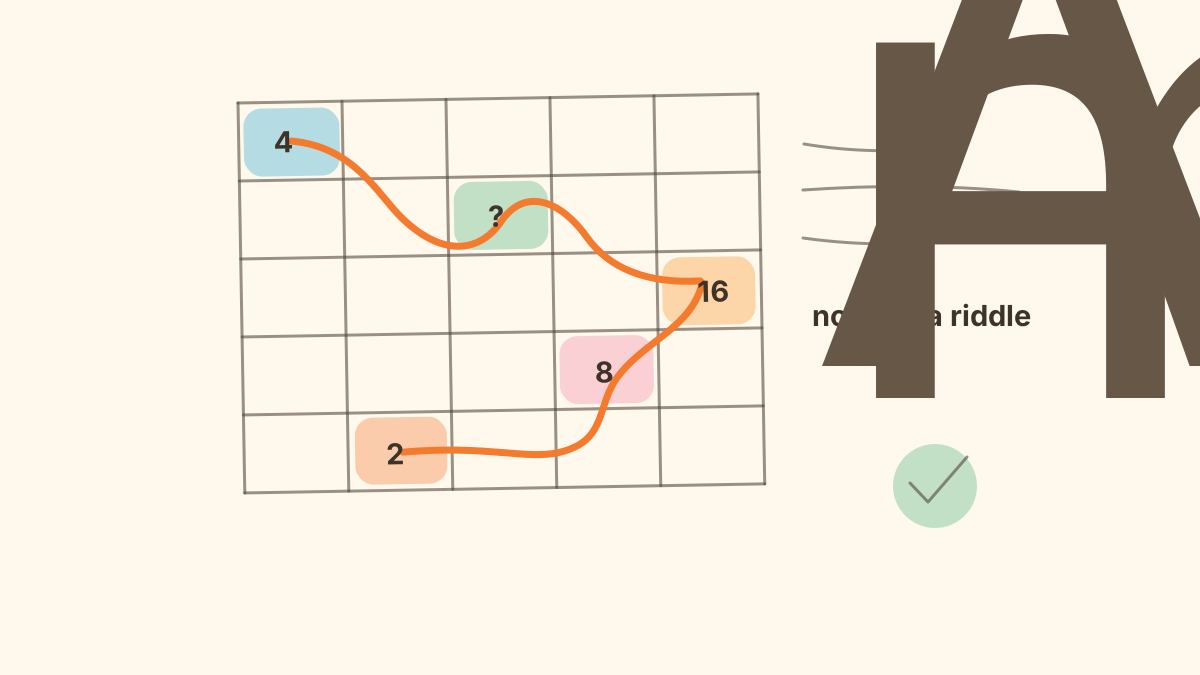
| Number pattern | Predicts or completes a sequence | 2, 4, 8, ? |
| Logic constraint | Uses rules to eliminate choices | Only one tile can fit here |
| Spatial structure | Rotates, matches, or compares shapes | Which piece completes the grid? |
Math & Patterns lives across those types. Some rounds are arithmetic. Some are speed and comparison. Some are visual or structural. The important part is that the task stays visible.
What the current search results teach us
The DataForSEO SERP snapshot for “math puzzles” included Math Is Fun, a Dartmouth puzzle PDF, Scientific American, Reddit, and Teachers Pay Teachers.
That tells us the searcher may be looking for entertainment, classroom material, or a serious puzzle source.
Math & Patterns should not try to be all of those.
The better position is this: a phone-friendly way to practice puzzle thinking in short rounds.
That is more specific than “a big collection of puzzles,” and more honest than claiming to replace a math enrichment program.
After a puzzle, ask: “What did you notice?” If the answer is about a relationship, order, shape, count, or rule, the puzzle probably did some useful math work.
What bad math puzzle games do
Bad puzzle games hide the rule. The player guesses until the app says yes.
They may also over-reward speed before the player has understood the structure. Or they may load the screen with so many animations that the actual pattern becomes hard to see.
Another common problem: one-and-done puzzles. The child solves a riddle, remembers the trick, and the puzzle has no practice value left.
Short replayable games solve a different problem. They let the player notice a pattern, make a mistake, and immediately try another version.
Number sense comes from comparisons
Number sense is not only knowing facts. It is feeling how numbers relate.
Which answer is bigger? Which value is missing? Which pattern is changing? Which result is impossible?
Puzzle games can build that sense when they force the player to compare instead of merely compute.
For example, a true-or-false arithmetic round can be useful because the player has to judge the relationship, not write out a full solution. A number-order round can be useful because the player has to compare values under pressure.
Those are small decisions, but they are real math decisions.
Where Math & Patterns fits
Math & Patterns is not a giant puzzle archive. It is not a contest math site. It is not a printable worksheet library.
It is a set of short math and pattern games designed for quick practice, including rounds that ask players to compare, order, match, react, and recognize structure.
That makes it a good fit for families who want puzzle-like practice without turning every session into a long lesson.
The goal is simple: one visible thinking move, repeated often enough to improve.