This is a thought experiment, not a partnership claim.
Math & Patterns is not affiliated with Headspace, Duolingo, or Chess.com. But those three products make a useful triangle for thinking about math practice.
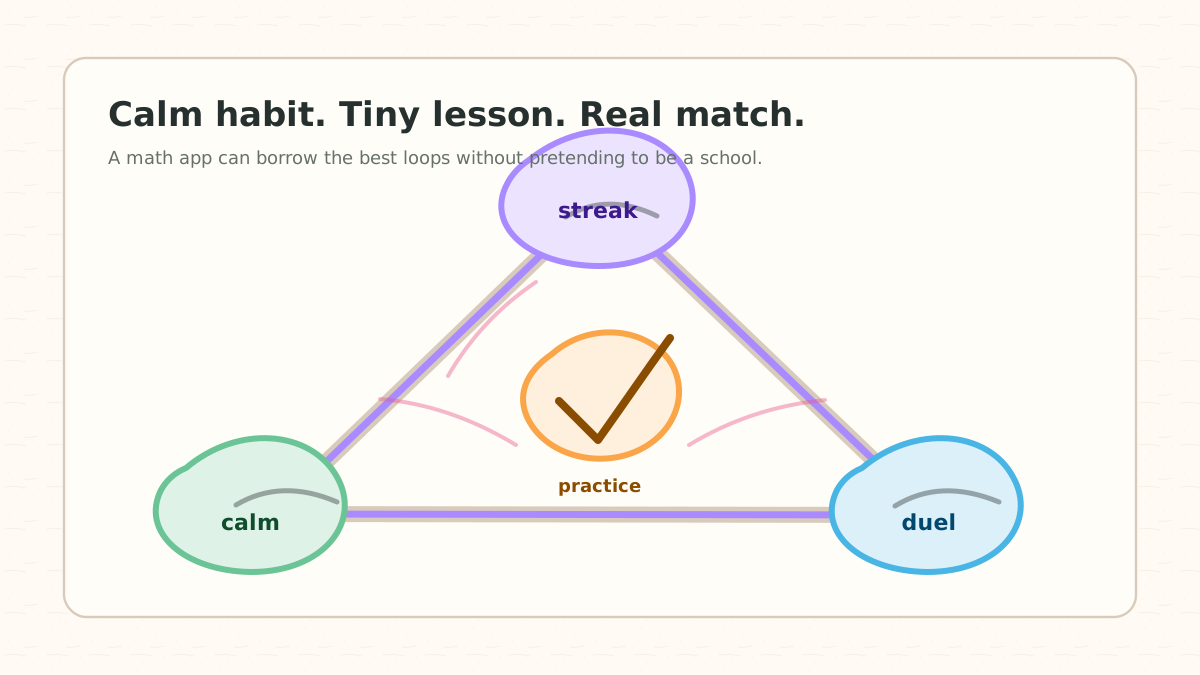
Headspace suggests calm entry. Duolingo suggests a small daily habit. Chess.com suggests puzzles, live play, friends, and a reason to keep improving.
If you put those ideas together, you get a better question than “What is the best math app?”
You get: what would make a person actually want to start math practice today?
The Headspace part: lower the pressure
Math practice often arrives with baggage. Grades, speed, comparison, embarrassment, and a feeling that being wrong means being bad at math.
A Headspace-like math app would not turn math into meditation. It would borrow the softer entry: open the app, do one clear thing, finish without drama.
That matters for children who freeze before the work starts. It also matters for adults who have not touched mental math in years and do not want to feel twelve again.
The calm part is not cosmetic. It is a product requirement.
The Duolingo part: make it easy to repeat
Duolingo’s math page now presents bite-sized lessons and step-by-step help across a broad grade range. The broader lesson is obvious: small loops beat giant intentions.
Most parents do not need another app that says “practice more.” They need an app that makes the next practice session obvious.
A good math loop should be:
| Loop part | What it should do |
|---|---|
| Start | Ask for one small action |
| Problem | Practice one visible skill |
| Feedback | Show what happened quickly |
| Finish | End before the user resents it |
| Return | Make tomorrow’s start easier |
This is where Math & Patterns fits. It does not try to teach a whole course in one path. It gives a set of short games that can become a daily habit.
The Chess.com part: make practice social and skillful
Chess.com is a good metaphor because it makes practice feel like participation. You can play, solve puzzles, learn, watch, and compare yourself with others.
Math rarely gets that treatment. It is usually private. You work alone, then someone checks whether you were right.
Live duels change that. A fair math duel lets the learner experience math as a game against another person, not a private test against a page.
The key word is fair. A duel should reward the intended skill. If the round is about pattern recognition, the score should reward clean pattern recognition. If it is about speed, the app should make that explicit.
Headspace, Duolingo, and Chess.com are used here as familiar product references. Math & Patterns is its own app, with its own design and its own limits.
What the baby would look like
It would have one-minute games.
It would have a daily challenge.
It would have live duels against real opponents, not fake bots pretending to be people.
It would let someone start without an account, then use an account when they want synced progress, friends, rankings, and multiplayer.
It would avoid the two worst extremes: dry worksheets with no joy, and noisy game layers where the math disappears.
That is the Math & Patterns direction.
What it would not be
It would not replace a full curriculum.
It would not diagnose every gap.
It would not promise that a child will love math after three rounds.
It would not pretend every competitor is bad. Duolingo Math, Prodigy, IXL, Beast Academy, SplashLearn, and Khan Academy all solve real problems for different families.
The point is narrower: there is room for a math app that treats practice like a good phone game without making the math fake.
Why this matters for adults too
The DataForSEO snapshot showed stronger volume for “math games for adults” and “mental math games” than for many child-specific comparison phrases. That is important.
Adults also want low-pressure practice. Teens also want something less babyish. Parents often want to play alongside their children without feeling like they are opening a classroom portal.
A calm habit loop with real competition can serve all three groups.
That is what the baby should inherit: Headspace’s gentle start, Duolingo’s repeatable habit, Chess.com’s competitive puzzle energy, and Math & Patterns’ focus on short math games.