Searching for “games like Prodigy Math” usually means one of two things.
Either your child likes Prodigy and you want more game-based math. Or your child does not quite fit Prodigy, and you want a different shape of practice.
Those are different searches. The first is about similar motivation. The second is about a different product philosophy.
In the DataForSEO snapshot for this batch, both “math games like Prodigy” and “games like Prodigy Math” showed 170 average monthly US searches. That is not massive, but it is strong enough to deserve a clear comparison page because the intent is specific.
What Prodigy is good at
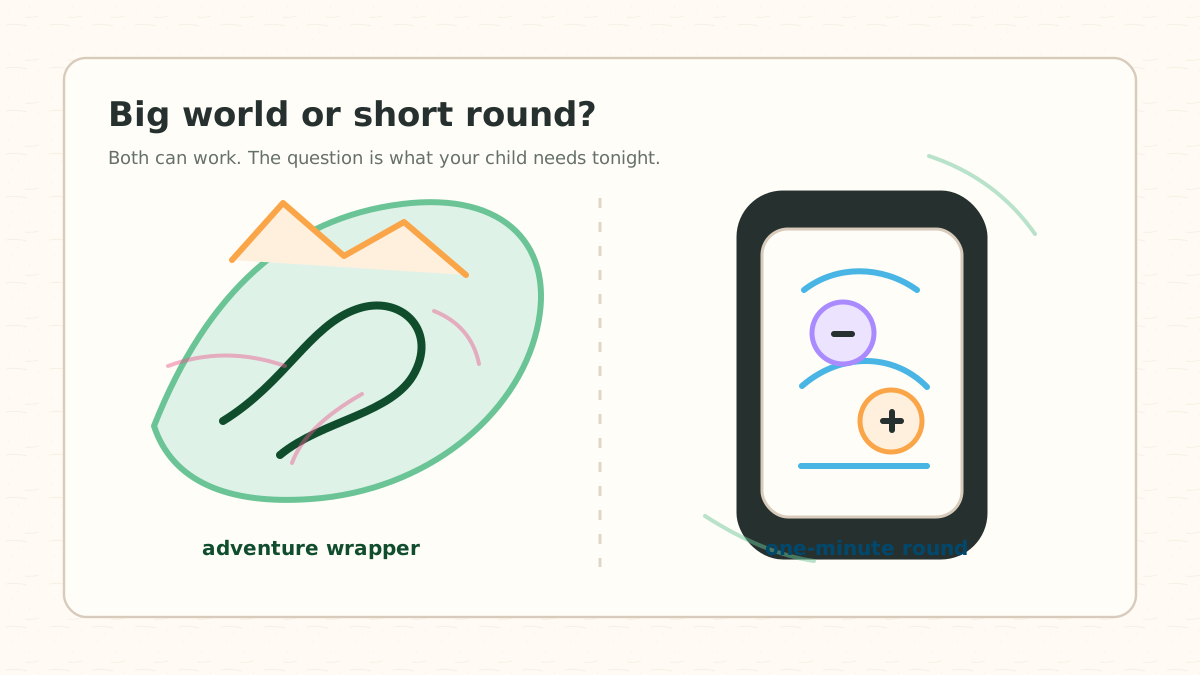
Prodigy Math is a large adventure wrapper around math practice. Its official product page describes adaptive math practice, fantasy-world exploration, curriculum alignment, grades 1 to 8, battles, quests, parent dashboards, teacher tools, reports, and optional membership features.
That is a real strength. Some children need a world before they will practice. They want characters, pets, places to go, and a sense that math unlocks something.
If your child loves that shape, Prodigy may be the better fit.
Why some families look for alternatives
A big world can also be the wrong size.
Some parents do not want another RPG loop. Some children get more interested in the rewards than the math. Some families only want five useful minutes, not a whole learning platform. Some older kids and adults want something less child-coded.
None of that makes Prodigy bad. It just means the search “games like Prodigy Math” often hides a better question: what part of Prodigy do you want, and what part are you trying to avoid?
If the child says they like the world, choose a world. If they say they like winning quick rounds, choose a round-first app.
Where Math & Patterns differs
Math & Patterns is round-first. It has twenty short puzzle games across arithmetic, algebra, geometry, logic, speed, and special categories. Selected games are playable in the browser, and the full app adds live duels, daily challenge, friends, and rankings.
It is not trying to surround every math question with a fantasy story. The round is the wrapper.
That makes it better for:
| Parent need | Why Math & Patterns may fit |
|---|---|
| Quick phone-friendly practice | Rounds are short and easy to start |
| Multiplayer math | Live duels are central to the app experience |
| Less child-coded practice | The visual language is more puzzle-like than cartoon-RPG |
| Practice after a lesson app | It works as repetition, not full instruction |
| Browser trial first | Four games can be played on the web |
Where Prodigy may still win
Choose Prodigy if you need grade 1-8 curriculum alignment, teacher tools, parent reports, a large adventure structure, pets, quests, and a system your child can stay inside for longer sessions.
Choose Math & Patterns if you need short, clean math games, a stronger multiplayer angle, and a product that feels more like a phone game with real math inside.
The honest answer is not “Prodigy is boring and we are better.” That is lazy.
The honest answer is that many math apps are curriculum-first. Math & Patterns is play-first, but still has to keep the math visible.
A good replacement test
Before replacing any math app, run a one-week test.
On two days, use the big-world app.
On two days, use a short-round app.
On one day, use a paper or whiteboard problem with no app at all.
Then ask three questions: Which one did your child start with the least resistance? Which one made them explain the math afterward? Which one could you repeat without a fight?
The best choice is the one that survives all three.