A number bond is a whole split into parts. For bonds to 10, the whole stays fixed at 10 while the two parts change.
That makes the central question very concrete:
If one part is 7, how many spaces are still needed to fill 10?
The answer is 3, so 7 + 3 = 10. This is not a trick to remember. You can see it, build it and check it.
See the bond in a ten-frame
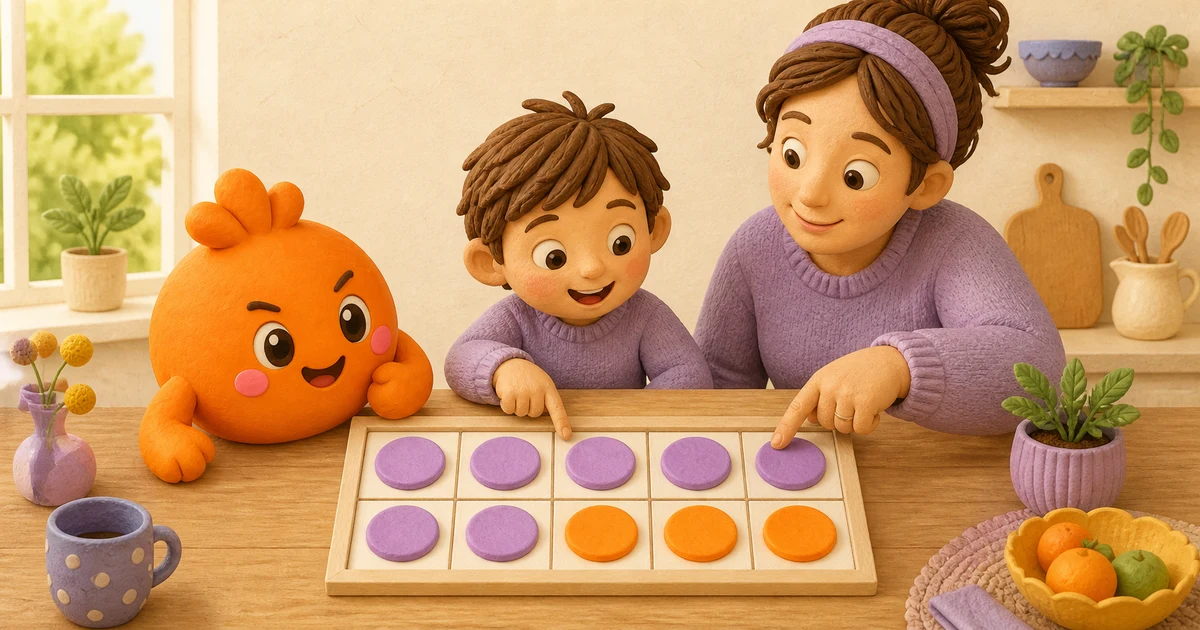
Draw two rows of five boxes. Put one counter in each box until you have shown the known part.
For 7 + ? = 10:
- Fill seven boxes.
- Count the three empty boxes.
- Fill those spaces with a second colour.
- Check that all ten boxes are now full.
The filled boxes show the known part; the empty boxes reveal its partner. This is why a ten-frame is useful: the target is visible before any calculation begins.
Try the same routine without moving on until you have checked each full sum:
- 2 + ? = 10 gives 2 + 8 = 10.
- 9 + ? = 10 gives 9 + 1 = 10.
- 5 + ? = 10 gives 5 + 5 = 10.
- 0 + ? = 10 gives 0 + 10 = 10.
The complete set of partners
Start at zero and move one counter from the second part to the first part each time:
- 0 + 10 = 10
- 1 + 9 = 10
- 2 + 8 = 10
- 3 + 7 = 10
- 4 + 6 = 10
- 5 + 5 = 10
You can stop at 5 + 5 because the pairs then repeat in reverse: 6 + 4 uses the same two parts as 4 + 6.
This symmetry halves the amount you need to organise. It also gives a useful check: if you know 3 + 7, then 7 + 3 must reach the same total.
A three-step missing-part method
When the counters are no longer in front of you, keep the same logic:
- Name the target: “I need 10.”
- Find the gap: count on from the known part, or calculate 10 minus that part.
- Verify the pair: add both parts and confirm the result is 10.
For 6 + ? = 10, the gap from 6 to 10 is 4. The check is 6 + 4 = 10.
For ? + 8 = 10, the gap from 8 to 10 is 2. The check is 2 + 8 = 10.
Writing the check matters. It catches answers that are close to 10 but do not actually complete the target.
Play a partner hunt
One child and one adult can run this with ten counters, coins or scraps of paper.
- The adult hides some of the ten objects under a cup.
- The child counts the objects still visible.
- The child predicts how many are hidden.
- Lift the cup and verify the total.
If six are visible, the prediction should be four hidden. Swap roles after each round. To make the reasoning audible, ask for a full statement: “Six and four make ten.”
The activity stays focused when the target remains 10 and only the split changes. For broader short-session ideas, see arithmetic games for short practice. When the next goal is checking a calculation rather than composing a total, use the separate routine in how to estimate and check maths answers.
What Math & Patterns actually offers
Math & Patterns lists Make 10, whose current task is to find pairs of numbers that add to a target. Its catalogue page is an app-only next step, not a browser demo. The hands-on partner hunt above works without the app and demonstrates the same narrow pair-to-target idea.
Number bonds are useful facts, but this page does not promise that one game or one routine will produce fluency. The immediate goal is smaller and testable: find a partner, state the full sum and check that it reaches 10.
Sources and further reading
- England’s primary mathematics national curriculum includes representing and using number bonds within 20 and specifically discusses reasoning with bonds to 10 and 20.
- NRICH’s Pairs of Numbers teacher guidance develops fixed-total partner reasoning through a practical number-pair task.