The target tile is easier to understand when you pull it apart.
Start with 64. If a move may merge only two equal values, the last move must combine 32 and 32. Each 32 needs two 16s. Keep reversing and a complete merge tree appears.
| Target | Equal tiles needed one step earlier |
|---|---|
| 64 | 32 + 32 |
| 32 | 16 + 16 |
| 16 | 8 + 8 |
| 8 | 4 + 4 |
| 4 | 2 + 2 |
So one 64 contains the same total as thirty-two 2 tiles.
The NRICH Sissa’s Reward problem explores repeated doubling through a chessboard story. Here we use the same number relationship for a different task: planning merges backwards before touching the board.
Draw the merge tree
Write 64 at the top of a page. Draw two branches down to two 32s. Split each 32 into two 16s.
After three levels, the page shows:
- one 64
- two 32s
- four 16s
- eight 8s
Continue if you want the full tree. You will get sixteen 4s and thirty-two 2s.
This also counts the merges. Thirty-two starting tiles must become one tile, so 31 merges are needed. Each merge reduces the tile count by one.
That count is arithmetic, not a promise that every board position can make the target. Space can stop a correct number plan.
Try the five-merge challenge
Make these eight paper tiles:
4, 4, 4, 4, 8, 8, 16, 16
Your goal is to produce at least one 32 using exactly five merges. Only equal values may merge.
One route is:
- Merge 4 + 4 to make 8.
- Merge the other 4 + 4 to make 8.
- Merge those new 8s to make 16.
- Merge the two starting 8s to make 16.
- Merge two 16s to make 32.
Several 16 tiles remain, but the target has appeared.
Now remove the five-merge rule. What is the shortest solution? Merge the two starting 16s: one move makes 32. The longer route practises the doubling chain; it is not the quickest way to reach this target.
Ask a second question. Which merge would you avoid if the board had only one open lane? The smallest merge is not automatically the best first move. A new 8 placed in the wrong gap can separate the equal 16s you need later.
Add a space rule
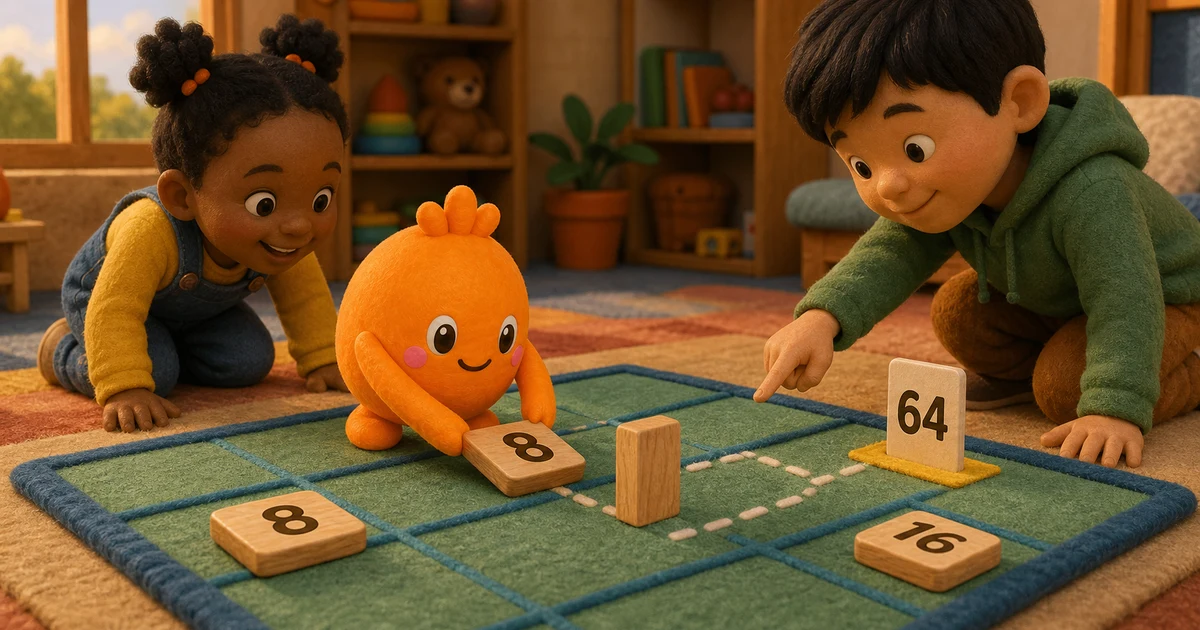
Draw a three by three grid. Place a coin in the centre as a blocked cell.
Put two 8 tiles on opposite sides of the coin and a 16 near one edge. Now plan a route that brings the 8s together without sealing the 16 behind them.
You do not need to imitate any app controls. Slide the paper tiles one square at a time and agree on the movement rule before starting. The point is to make the trade-off visible:
- arithmetic says which values can merge
- the grid decides whether they can meet
If a route fails, reset the pieces and change the first move. Do not change the arithmetic rule.
Check a common mistake
Can 8 and 16 merge to make 24?
Their sum is 24, but they are not equal. Under this puzzle’s rule, they cannot merge. The next legal partner for 8 is another 8. The next legal partner for 16 is another 16.
That restriction is what preserves the powers-of-two ladder:
2, 4, 8, 16, 32, 64
For a different sort of number-pattern challenge, try solving a sequence without guessing.
Math & Patterns’ Power Shift is an app game with equal-tile merges, target values, move limits and later blocked cells. Its web page is an app handoff. No affiliation with 2048 is implied.