Set a timer for one minute. Name as many animals as you can without repeating one.
That is a category word-fluency task in its simplest form. The rule is semantic: entries belong because of what they mean.
Bowdoin College’s Semantigories research project describes category fluency as listing members of a category in one minute. Here we are borrowing the format for a friendly paper game, not administering or interpreting a clinical test.
Round one: animals
You need paper, a pen and a one-minute timer. Agree these rules first:
- Each distinct animal counts once.
- Repeats do not count twice.
- A specific animal may count if everyone accepts it as a genuine member of the category.
- Spelling does not need to be perfect if the intended word is clear.
- Stop writing when the timer ends.
One possible list is:
dog, cat, hamster, cow, sheep, pig, cod, shark, ray
That list contains nine unique entries under the stated rules. Nine is not a benchmark. It is just the count for this example and this category.
For two players, write separately, then compare. A word that appears on both lists still counts for each player. Settle disputed entries by returning to the agreed category rule, not by changing it after the timer.
Use clusters as search routes
The example list did not jump randomly. It moved through smaller groups:
- pets: dog, cat, hamster
- farm animals: cow, sheep, pig
- sea animals: cod, shark, ray
These are clusters inside the larger animals category. When one cluster runs dry, switch to another.
Try drawing three empty circles before the round and labelling them with possible clusters. The circles are prompts, not extra points. For “foods”, your clusters might be fruit, vegetables and breads. For “things that move”, you might choose road, rail and water.
The structure is similar to an odd-one-out explanation: the rule matters more than the surface list. A whale could belong to animals, sea animals or things that move, depending on the current question.
Round two: change to a word stem
Now use a different rule. Write ST- at the top of the page and list words that begin with those letters.
For example:
star, stone, stop, stick, steam, store
These words do not form one meaning category. They belong because they share the same opening letters.
That makes the distinction clean:
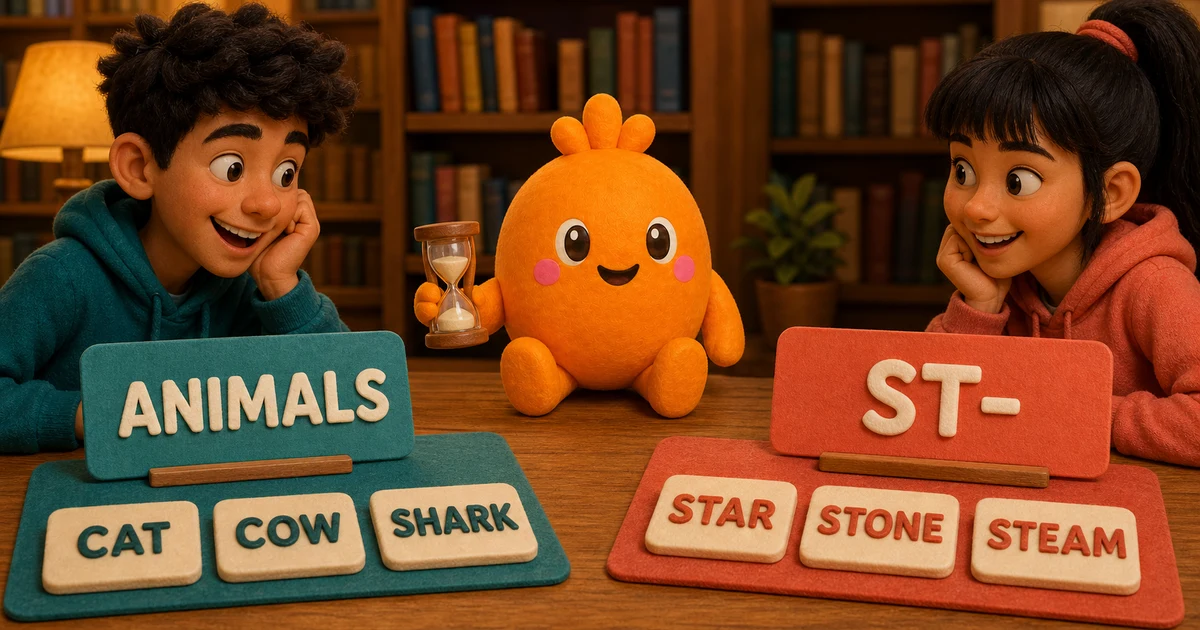
| Format | Membership rule | Example prompt | Valid examples |
|---|---|---|---|
| Category | shared meaning | animals | cat, cow, shark |
| Word stem | shared starting letters | ST- | star, stone, steam |
Do not call the stem round “category fluency”. Do not count “cat” in the ST- round just because it worked in the animals round.
Make the round fair and useful
Use the same timer and counting rules when comparing two attempts. Change only one variable if you want to observe what happened:
- same category, different cluster prompts;
- same stem, longer planning time before the timer;
- same rules, player writes versus player speaks while a partner records.
A higher count may reflect familiarity with the topic, spelling speed, recording method, language experience, distraction or the particular prompt. It does not establish brain health, memory ability or a diagnosis.
The result can still support a useful conversation. Which cluster produced the longest run? Where did repeats appear? Did the player switch clusters when stuck, or keep searching the same small patch?
A friendly three-round set
- Category: things found in a kitchen.
- Category: shapes.
- Stem: BR-.
After each round, circle any repeated word and draw a line between entries that form a small cluster. Do not rank categories by raw count because some simply contain more familiar words for a given player.
Math & Patterns’ Word Bubbles is available for browser practice. It supplies a word stem, rejects duplicate or invalid submissions, and scores accepted words during a timed round. It does not run a semantic-category task.
Sources and further reading
- Bowdoin College’s Semantigories project explains the one-minute semantic-category format and research context.
- The Word Fluency Test explainer discusses category and letter-based formats, clustering, switching search routes and the no-repeat rule.