An odd-one-out puzzle is a classification problem. You are not continuing a sequence or guessing what the author was thinking. You are looking for a property that forms a group and leaves one justified exception.
Use three verbs:
- Solve: propose a shared rule.
- Test: check every item against it.
- Explain: name the exception and show the evidence.
The method matters because some well-chosen sets allow more than one correct answer.
Try this set before reading on
Which is the odd one out?
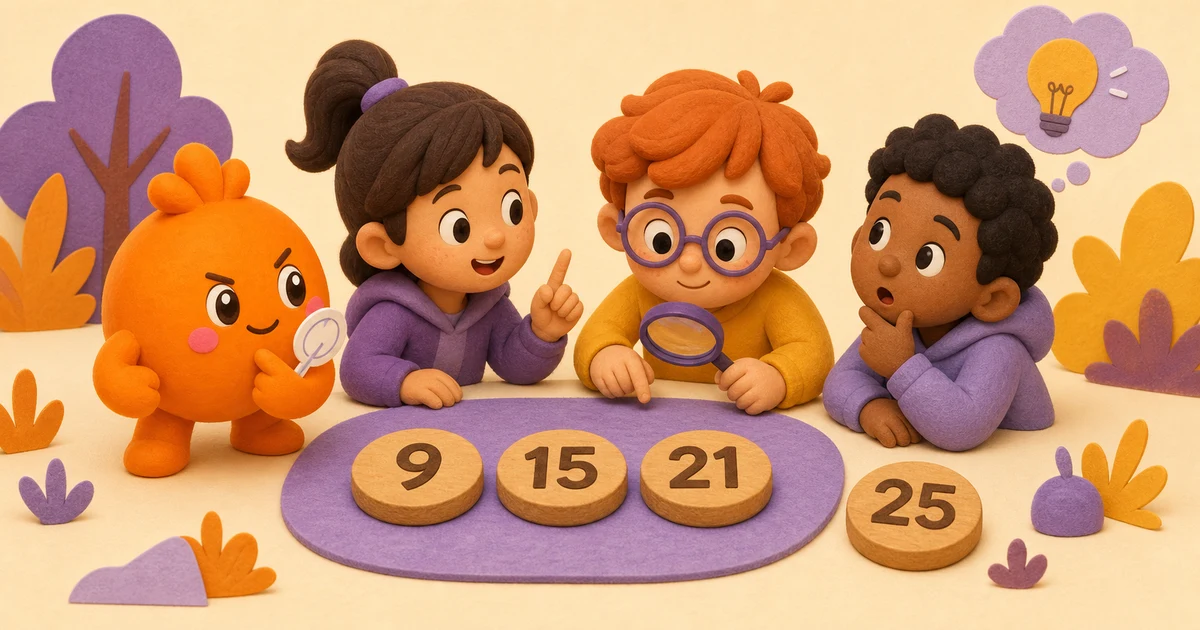
9, 15, 21, 25
Pause and write one complete sentence: “___ is the odd one out because ___.”
One strong answer is:
25 is the odd one out because 9, 15 and 21 are divisible by 3, while 25 is not.
Test it:
- 9 ÷ 3 = 3
- 15 ÷ 3 = 5
- 21 ÷ 3 = 7
- 25 is not a multiple of 3
The rule fits all four items and leaves exactly one exception.
Two other answers also work
Choose a different property and the classification changes.
9 can be the odd one out because it is the only one-digit number. The other three are two-digit numbers.
15 can be the odd one out because it is the only number divisible by both 3 and 5. Nine and 21 are divisible by 3 but not 5; 25 is divisible by 5 but not 3.
None of those answers cancels the others. Each one states a different invariant—a property shared by the selected group—and checks every item.
An answer becomes weak when it describes only the chosen item. “25 is biggest” is true, but it still works as a classification only if the intended shared rule is “the other three are not the greatest.” A property such as divisibility usually reveals more mathematical structure.
A reliable search order
When no rule appears immediately, test properties in a fixed order:
- Parity: odd or even.
- Multiples and factors: divisible by 3, a factor of 24, and so on.
- Place value: one digit versus two, a repeated digit, a particular tens digit.
- Special families: square numbers, primes, triangular numbers.
- Digit relationships: digit sum, difference or reversal.
Do not combine unrelated facts just to force an answer. The best rules are short, exact and easy for another person to test.
Turn the explanation into a proof check
Use this sentence frame:
“___ is the odd one out under the rule ___; the others satisfy it because ___.”
Then challenge the solution:
- Did I test every item?
- Does exactly one item fail my rule?
- Did I accidentally change the rule halfway through?
- Can someone reproduce my check?
This changes the puzzle from “spot what looks strange” into a small mathematical argument.
Make your own puzzle
Start with a property rather than four random numbers.
For example, choose three multiples of 4: 8, 16, 28. Add one nearby non-multiple, such as 26. Before sharing it, test whether an accidental second rule makes a different answer obvious. Multiple answers are not automatically a defect, but you should know they exist.
Ask a partner for two solutions. If they find an unexpected one and can test it across the whole set, keep it. That surprise is useful reasoning, not a failure to follow the answer key.
This task is different from deciding the next term in an ordered list. For continuation tests, use how to solve number sequences. For the broader role of noticing regularities in early maths, see why pattern recognition matters; this page stays on classification and justification.
What Math & Patterns actually offers
Math & Patterns lists Odd One Out, whose current task is to find the number that does not fit a pattern. The catalogue route is app-only, so the button does not claim browser play. The worked set above is a complete screenless version you can solve with another person now.
Sources and further reading
- England’s primary mathematics national curriculum makes reasoning, mathematical argument and clear spoken explanation explicit aims.
- NRICH’s Number Detective teacher guidance prompts children to choose an odd one out and justify it with number properties such as place value, parity and multiples.