Number-sequence puzzles become much easier when you stop searching for a flash of inspiration and start running a short set of tests.
The central discipline is simple: do not accept a rule because it explains only the last jump. It must fit every term shown.
The sequence-solving checklist
Use these tests in order:
- Differences: subtract each term from the next.
- Ratios: divide each term by the previous term when the values allow it.
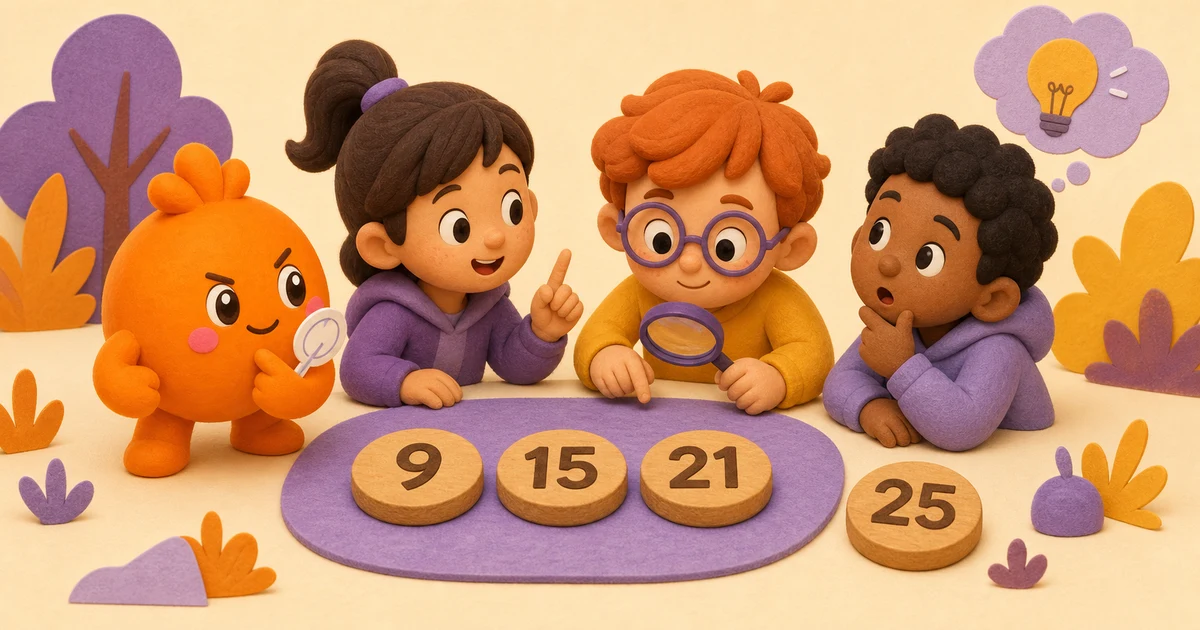
- Alternating positions: inspect the first, third, fifth terms separately from the second, fourth, sixth.
- Operation cycles: look for a repeating pattern such as add, add, multiply.
- Recurrence: test whether a term is made from one or more earlier terms.
- Whole-sequence check: apply the proposed rule to every transition.
This order starts with the cheapest explanations and only adds complexity when the simpler checks fail.
Example 1: constant differences
Consider:
4, 7, 10, 13, …
The consecutive differences are +3, +3 and +3. Continuing that rule gives 16.
The important step is not merely spotting that 13 can become 16. It is verifying that the same +3 rule connects 4 to 7, 7 to 10 and 10 to 13.
Example 2: constant ratios
Consider:
3, 6, 12, 24, …
The differences change, but each term is twice the previous term. The constant ratio is 2, so the next term under that rule is 48.
Ratio checks are particularly useful when gaps grow quickly. They are less useful when zeroes or sign changes make division misleading, so treat them as one test rather than a universal recipe.
Example 3: two interleaved sequences
Consider:
2, 9, 4, 12, 6, 15, …
The consecutive gaps look untidy. Split the positions:
- First, third and fifth: 2, 4, 6.
- Second, fourth and sixth: 9, 12, 15.
The odd-position sequence rises by 2; the even-position sequence rises by 3. The seventh term would therefore be 8, and the eighth would be 18.
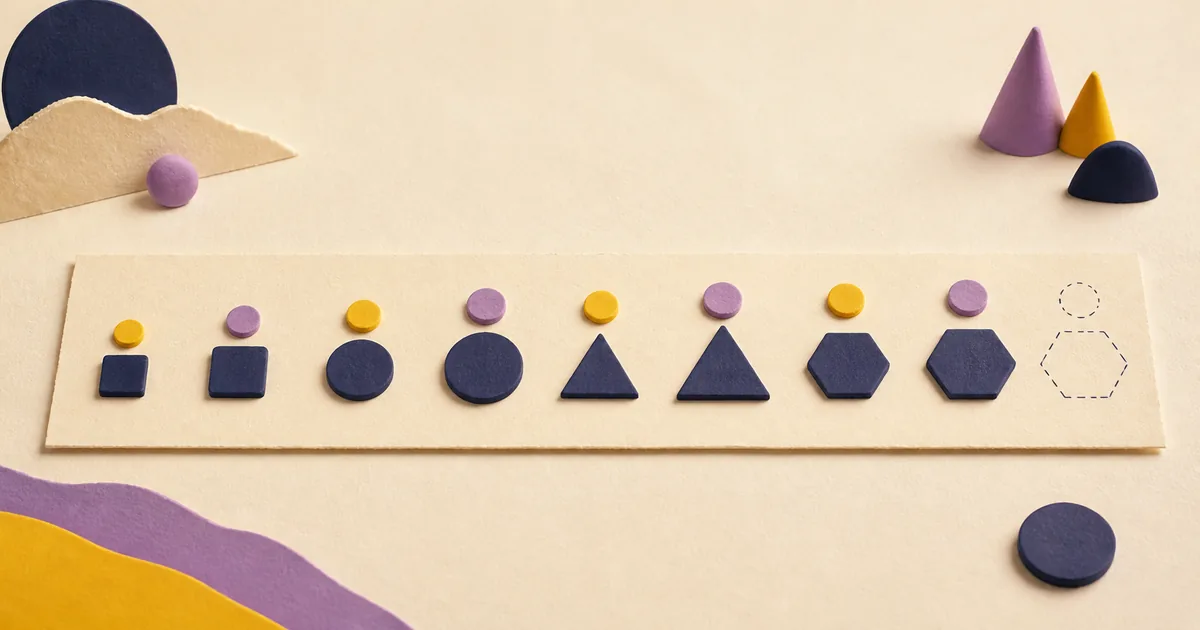
Alternating colours, shapes or spacing often signal this structure in visual puzzles, but the numbers themselves must still support it.
Example 4: recurrence
Consider:
1, 1, 2, 3, 5, …
From the third term onward, each term is the sum of the two before it. That produces 2, then 3, then 5, and gives 8 as the next term.
This is different from applying one operation to the immediately previous term. Write out the dependency explicitly so that you do not accidentally switch rules halfway through.
When first differences change
Changing differences can have a pattern of their own. For example:
2, 5, 10, 17, 26, …
The first differences are 3, 5, 7 and 9. Those differences increase by 2, so the next difference would be 11 and the next term 37.
This “differences of differences” method is useful, but it should not be your first explanation for every sequence. Prefer the least complicated rule that fits all terms and matches the puzzle’s context.
The ambiguity that puzzle books often hide
A finite sequence does not mathematically force a unique next number. Clever formulas can be built to match any finite list and then diverge. Even ordinary-looking lists can support two simple stories when too few terms are shown.
So “the answer” in a puzzle usually means the continuation intended by the author’s convention: commonly the simplest familiar rule that explains all displayed terms. If two similarly simple rules fit, the puzzle needs more information.
This is also why solving a sequence is not evidence of a fixed intelligence level. It demonstrates that you found a rule for that example.
A better way to practise
When checking a solution, ask for three things:
- State the rule in words.
- Show that it generates every given transition.
- Name one alternative you tested and rejected.
That turns a lucky continuation into a falsifiable argument. The same habit transfers naturally to visual fitting puzzles: count constraints, test a placement, and reverse it when it fails. See how to solve polyomino puzzles for that spatial version of the method.
Math & Patterns includes Odd One Out, described as finding the number that does not fit a pattern. Its page is an app-only next step; this article does not claim that a puzzle score measures intelligence or that the game is playable in the browser.
Sources and further reading
- The national curriculum in England for mathematics includes generating and describing number sequences and patterns across stages.
- Maths Is Fun’s number-pattern guide gives accessible examples of common pattern families.
- Its sequence differences tool demonstrates repeated-difference analysis.
- A current number-reasoning guide was reviewed as competitor context; its examples informed the need for a check-every-term method rather than any volume claim.