Reading is so practised that a written word can compete with a different instruction. Ask someone to report ink colour while ignoring the word itself, and a mismatch can slow the response.
That conflict is the basis of the Stroop effect.
Congruent, incongruent and neutral trials
Suppose the task is always to name the ink colour.
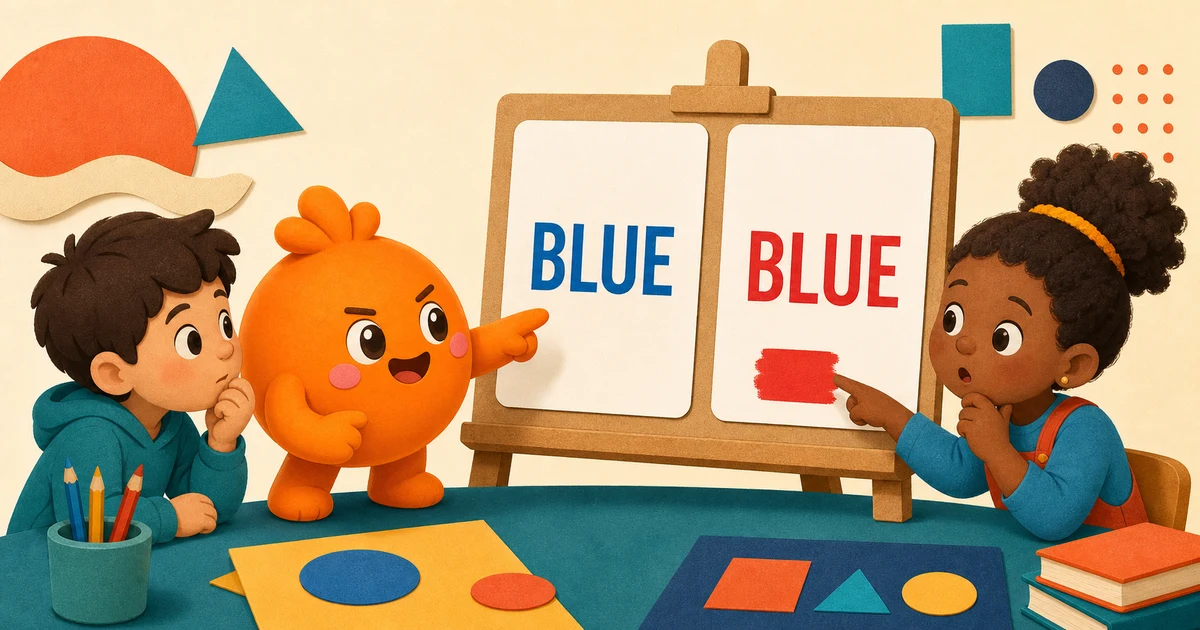
- Congruent: the word “blue” appears in blue ink.
- Incongruent: the word “blue” appears in red ink.
- Neutral: a non-colour item appears in red ink.
The incongruent item supplies two competing answers: the word says blue, while the ink says red. In the classic colour-naming task, incongruent conditions produce slower responses than appropriate control conditions.
The exact comparison matters. A neutral row of symbols is not identical to a congruent colour word, and reading a word aloud is not the same task as naming its ink. “The Stroop effect” is a family of carefully designed comparisons, not any colourful screen that feels difficult.
Why the conflict is noticeable
For fluent readers, word recognition is highly practised. The instruction to ignore meaning and report ink colour asks the response system to prioritise a less dominant feature while competing information is present.
It is tempting to describe that as one simple battle between an “automatic” and a “controlled” process. Reviews of the Stroop literature show a more complex picture. Stimulus set, proportion of matching trials, response mode, practice, language and other design choices can change the measured interference.
So the safe conclusion is task-specific: conflicting word meaning can slow colour naming under classic conditions. A single response time does not reveal a permanent level of attention or self-control.
Try the rule without confusing the measure
A colour-word game can make the conflict visible. To interpret a run:
- Confirm the instruction: report ink, word meaning, or match status?
- Separate accuracy from speed.
- Compare like with like: the same device, rule and difficulty.
- Look at several trials rather than one surprising miss.
- Treat learning the controls as part of practice, not as evidence of a changed trait.
If a game increases the proportion of mismatched items during a run, later scores are not directly comparable with earlier ones. If it awards reaction-time bonuses, a higher point total may combine accuracy, pace and difficulty.
What a casual game cannot establish
A browser or phone game is not automatically a standardised Stroop test. Without controlled administration, validated norms and an appropriate interpretation process, it cannot diagnose attention conditions, measure a stable personality trait or prove general cognitive improvement.
This limit does not remove the value of the game. Interference is an interesting perceptual challenge, and a transparent rule gives players something concrete to notice. The responsible claim is that the game instantiates a related conflict—not that it reproduces every laboratory condition.
Where Math & Patterns fits
Math & Patterns includes Color Word, described as deciding whether a word’s meaning matches its ink colour. Its page is an app-only next step, not one of the four current browser-playable demos.
That distinction is intentional. The catalogue connection is real, but this article makes no diagnosis, training guarantee or claim that a catalogue description equals a validated research task.
For another transparent comparison rule with different demands, read what a one-back task is.
Sources and further reading
- J. R. Stroop’s 1935 paper on interference in serial verbal reactions reports the experiments that gave the effect its name.
- Colin MacLeod’s review of half a century of Stroop research surveys mechanisms and design variations.
- The Franklin Institute’s Stroop effect activity provides an accessible demonstration while keeping the basic instruction visible.