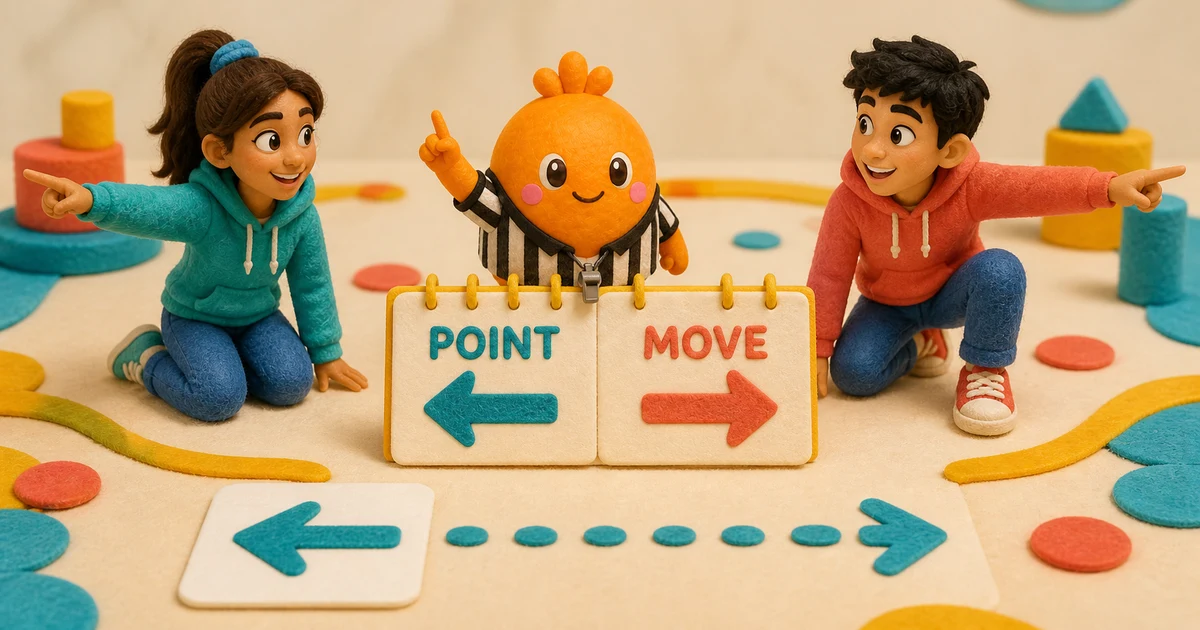
An arrow can point left while moving right. That single disagreement is enough to build a two-rule game.
- Under POINT, answer the direction of the arrowhead.
- Under MOVE, answer the direction the whole arrow travels across the card.
The picture can stay identical while the correct answer changes with the cue. That is the heart of this task.
Research on task switching cautions that switching between sets of rules and switching between features may involve different demands. The useful question is not “How flexible is my brain?” It is “What rule changed in this exact activity?” See the open-access paper Shifting set about task switching for that distinction.
Make four arrow cards
On each card, draw an arrow and a dotted travel path. The arrowhead and path must disagree.
- Arrow points left; path travels right.
- Arrow points right; path travels left.
- Arrow points up; path travels down.
- Arrow points down; path travels up.
Write POINT on one cue card and MOVE on another. One person shows a cue plus an arrow card. The player says left, right, up or down.
Keep the cue, arrowhead and travel path visible together so the player can apply either rule to the same card.
Play this eight-trial sequence
The correct response comes from the active rule, not from whichever part of the arrow feels most noticeable.
| Trial | Rule | Arrow points | Arrow moves | Correct answer | Trial type |
|---|---|---|---|---|---|
| 1 | POINT | left | right | left | first |
| 2 | POINT | right | left | right | repeat |
| 3 | MOVE | right | left | left | switch |
| 4 | MOVE | left | right | right | repeat |
| 5 | POINT | up | down | up | switch |
| 6 | MOVE | down | up | up | switch |
| 7 | MOVE | up | down | down | repeat |
| 8 | POINT | right | left | right | switch |
A switch occurs when the rule differs from the previous trial. A repeat keeps the previous rule. Trial 1 has no previous trial, so do not force it into either group.
The Focus Game task-switching explanation uses the same basic bookkeeping principle with different rules: a rule change defines a switch.
Keep a useful tally
Use three columns:
| Trial type | Correct | Incorrect |
|---|---|---|
| Repeat | ||
| Switch |
Do not combine everything into one mysterious score. If the player misses trial 6, ask what happened:
- Did they answer where the arrow pointed instead of where it moved?
- Did they overlook the MOVE cue?
- Did they know the rule but say the opposite direction?
Those are different errors. A quick note is more informative than a label such as “poor flexibility”.
For a second round, swap the cue meanings. Let POINT require the movement direction and MOVE require the arrowhead. Say the new mapping aloud before starting. The sequence is now familiar, but the rule bindings are not.
What this is not
This is not the same task as a Stroop colour-word round, where word meaning can conflict with ink colour. It is also different from a one-back task, which compares the current item with the immediately previous one.
Researchers can calculate switch costs under controlled conditions by comparing suitable repeat and switch trials. Our paper game does not standardise timing, practice, motor input or sequence balance. Treat its tally as a record of this round, not a cognitive or clinical assessment.
Math & Patterns’ Direction Swipe is available for browser practice and alternates between following an arrow’s pointing direction and its movement rule, recording rule changes. The game does not claim to measure a diagnosis or broad cognitive ability.
Sources and further reading
- Ravizza and Carter’s open-access paper Shifting set about task switching discusses how different kinds of switch can involve different demands.
- The Focus Game task-switching guide shows explicit cues, fixed mappings and separate repeat and switch summaries.