A one-back task is a moving comparison. You do not compare every item with a fixed target. You compare each new item with the item that came immediately before it.
That small change matters. The reference keeps moving, so the useful question is always: does this match the previous item?
A worked one-back sequence
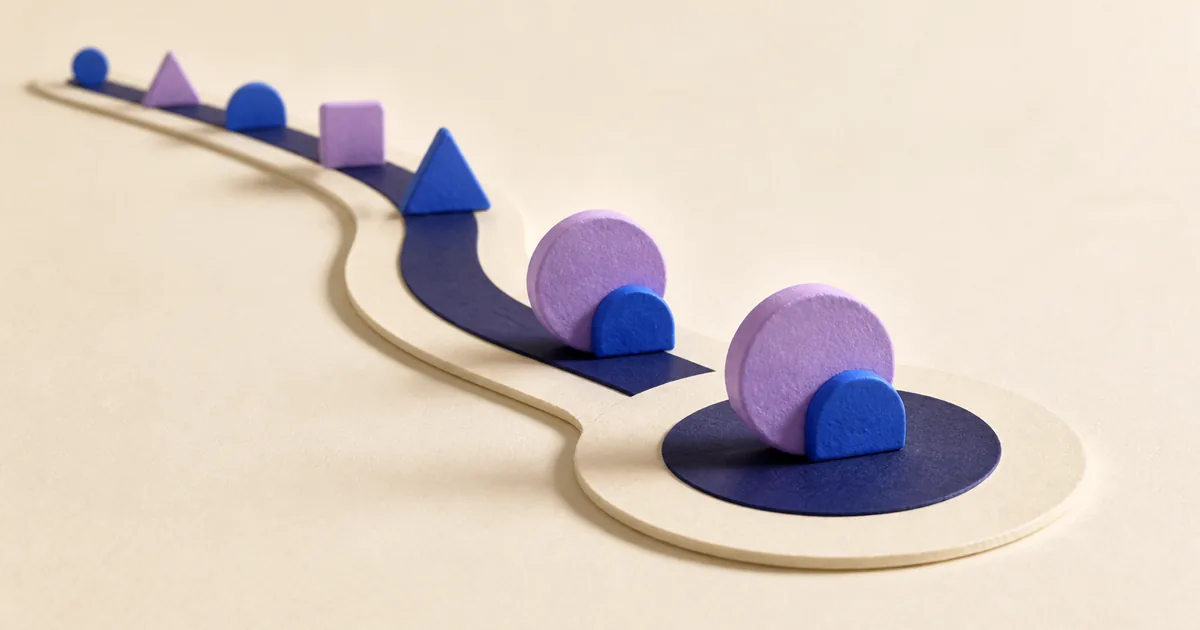
Imagine this sequence of shapes:
triangle — circle — circle — square — square — triangle
The first shape establishes the reference, so there is nothing to judge yet. Then:
- Circle after triangle: different.
- Circle after circle: same.
- Square after circle: different.
- Square after square: same.
- Triangle after square: different.
After every decision, the current item becomes the reference for the next one. Holding on to the first triangle for the whole sequence would produce the wrong rule.
What the “n” changes
In an n-back task, n is the number of positions between the current item and the item used for comparison.
- One-back: compare with the immediately previous item.
- Two-back: compare with the item two positions earlier.
- Three-back: compare with the item three positions earlier.
Increasing n changes the comparison distance, but that is not the only way tasks differ. Stimulus type, pace, match frequency, response options and scoring can all affect performance. A symbol game, a spoken-letter task and a research protocol should not be treated as interchangeable merely because each uses “n-back” in its description.
What a score actually records
A score can usefully describe what happened in that run: correct matches, correct non-matches, misses, false alarms, reaction time or a game-specific point total.
It cannot, by itself, isolate one permanent trait. A player may be learning the controls, reacting to a shorter timer, using a different screen, feeling tired or encountering an unusually difficult sequence. Those details are part of the measurement.
This is why careful research distinguishes improvement on the trained task from broader transfer. Reviews of working-memory training find that people can improve at the task they practise and sometimes at closely related tasks, while evidence for broad, durable gains is much less secure. A one-back game should therefore be described as a task or game—not as a diagnosis, an IQ test or a guaranteed route to better school or work performance.
For a fuller evidence guide, read what working-memory games actually test.
A simple accuracy check
When a one-back run feels confusing, separate the process into three beats:
- Name the current item silently.
- Compare it with the immediately previous item.
- After answering, replace the old reference with the current item.
This method is deliberately plain. Trying to retain the whole stream can add unnecessary load when the rule only needs one previous item.
Matches also need enough attention. In a long run of different items, a repeated pair can be easy to miss. Conversely, expecting a match can make two similar but non-identical symbols feel the same. Accuracy and reaction time describe different parts of the run, so a fast answer is not automatically a good one.
How Speed Match uses the rule
The browser version of Math & Patterns’ Speed Match shows digits and asks whether each new digit is the same as or different from the one just before it. Correct choices add one point, wrong choices reset the streak, and the game briefly shows feedback before moving to the next digit. This browser demo does not add escalating difficulty or speed-based score modifiers.
That makes it a one-back-style game with its own timing and scoring. It is not presented as a reproduction of a validated clinical or laboratory instrument. Use it for what it is: a short, transparent matching challenge whose rule you can inspect.
Sources and further reading
- A 2025 review of n-back methods and findings describes how task design varies across studies.
- A review of n-back clinical utility discusses measurement limits and the need for careful interpretation.
- A meta-analysis of working-memory training distinguishes task practice from claims of far transfer.
- The Math & Patterns explanation above was checked against the production Speed Match rule and its playable browser route.