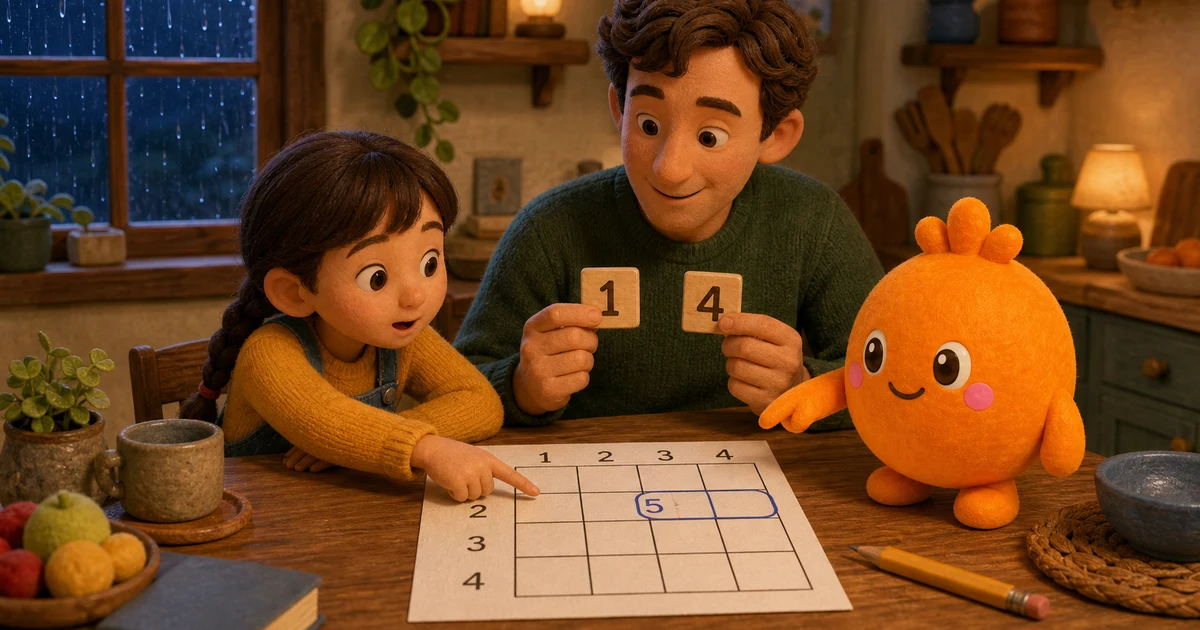
Working memory is often described as the limited mental workspace used to keep information available while doing something with it. A game can place demands on that workspace, but the label “working-memory game” does not make every score a general measure of the mind.
The useful starting point is narrower: what information does this round ask the player to retain, update or use?
Different games create different demands
A grid-recall round may briefly reveal several locations, hide them, then ask the player to select those locations. A one-back task asks whether the current item matches the previous item. A span task may require recalling a sequence in order or in reverse.
All can involve temporary retention, yet they differ in stimulus, timing, response, scoring and strategy. Someone may be strong at spatial chunking and slower with spoken sequences, or may understand one interface more quickly than another. Combining these scores into one vague “memory level” erases the design details that produced them.
Why practice scores usually rise
Repeated play can improve performance for several ordinary reasons:
- The instructions and controls become familiar.
- The player learns which details matter and which are distractors.
- Common patterns become easier to recognise.
- A deliberate strategy replaces trial and error.
- Responses become faster even when memory demand is unchanged.
Those changes are legitimate learning. The mistake is jumping from “I improved at this task” to “this game improved every activity that uses memory.”
Near transfer and far transfer
Researchers distinguish near transfer from far transfer. Near transfer means improvement on tasks similar to the training task. Far transfer means improvement on more distant outcomes, such as broad intelligence tests, school attainment or everyday performance.
Meta-analyses of working-memory training have found much firmer evidence for trained-task and near-transfer gains than for broad, durable far transfer. Results also depend on study design, comparison groups and the outcome chosen.
That evidence does not make memory games pointless. It changes the honest promise. A game can be an engaging challenge and a place to practise a particular rule without claiming to treat ADHD, prevent dementia, raise IQ or guarantee academic improvement.
Chunking changes the effective task
Suppose six highlighted cells form two compact L-shapes. Remembering “two L-shapes” may be easier than retaining six unrelated positions. That is chunking: organising separate items into a smaller number of meaningful groups.
Visual-memory research shows that grouping can alter how information is encoded and retrieved. But chunking is not free extra capacity. It works when the pattern has a structure the player can use. Six randomly scattered cells may resist the same strategy.
A practical grid method is:
- Scan the whole board once.
- Group adjacent cells into simple shapes or regions.
- Anchor each group to an edge, corner or centre.
- Reconstruct the groups before checking isolated cells.
This makes the strategy visible. If the score rises, you can say that the new encoding method helped on that task; you still cannot infer a clinical change.
How to read a score responsibly
Before comparing two runs, ask:
- Was the grid or sequence length the same?
- Was exposure time the same?
- Were errors penalised in the same way?
- Did the player use the same device and controls?
- Was accuracy traded for speed?
A point total that mixes several factors may be useful for play while being poor evidence for a scientific conclusion. Raw accuracy, sequence length and response time often answer different questions.
The same caution applies to one-back tasks: a transparent rule can produce a good game without becoming a diagnosis.
Where Math & Patterns fits
Math & Patterns includes Grid Memory, described as briefly showing tile positions and asking the player to recreate them after they go dark. Its page is an app-only next step; this article does not imply that it is one of the four current browser-playable demos.
The appropriate use is modest: play a round, notice the strategy you used, and interpret improvement in relation to that rule. That is more useful than attaching an unsupported claim to the score.
Sources and further reading
- A meta-analysis of working-memory training and far transfer reports a strong distinction between task-specific improvement and broader claims.
- A second-order meta-analysis of near and far transfer examines how conclusions change across prior reviews.
- A review of working-memory capacity discusses capacity limits and competing models.
- A study of visual chunking and working memory examines how grouping affects representation.