A cage total is not an invitation to guess. It is a short list.
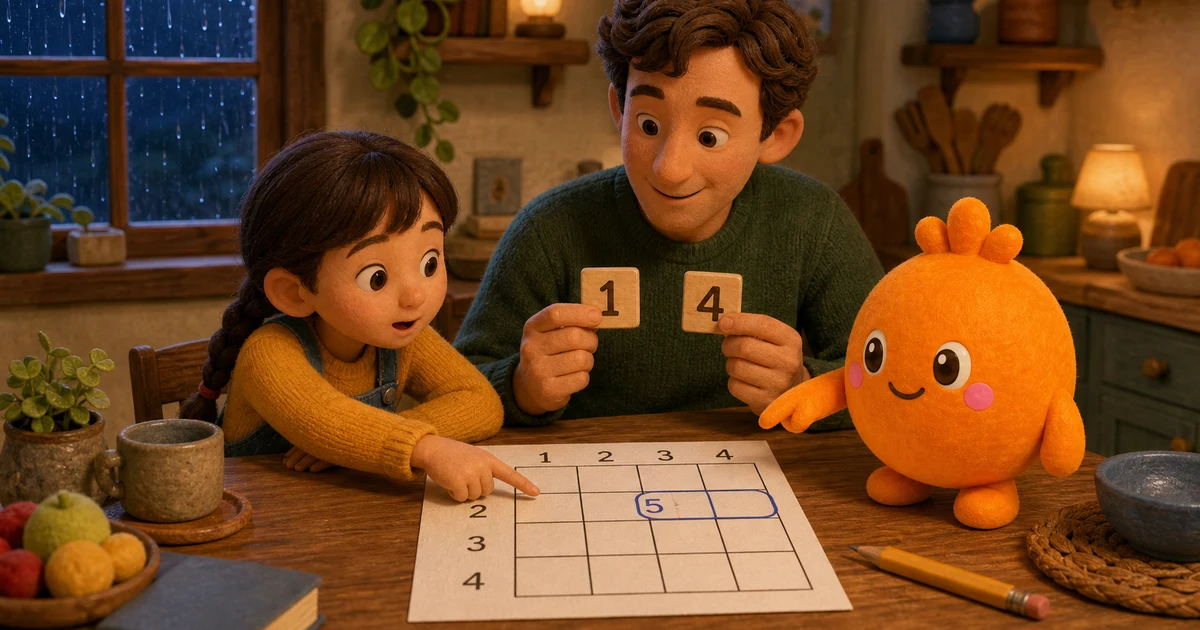
Suppose a two-cell cage in a 4 by 4 grid is labelled 5. The allowed digits are 1, 2, 3 and 4. Only two unordered pairs make 5:
- 1 and 4
- 2 and 3
That is already better than four blank possibilities in each cell. The row and column can usually do the rest.
Addition cages appear in several puzzle families. The KenKen rules page explains the wider arithmetic-cage format. The starter below is original and uses addition only. It does not claim any affiliation with that puzzle brand.
The four rules for this starter
Use a 4 by 4 grid.
- Each row contains 1, 2, 3 and 4 once.
- Each column contains 1, 2, 3 and 4 once.
- Each marked 2 by 2 region contains 1, 2, 3 and 4 once.
- The digits in each cage add to its target.
The mathematics programme of study for England includes using the four operations in problems. A cage puzzle makes the addition constraint visible, but it does not guarantee a learning outcome.
Copy this addition-cage starter
Write candidate pairs beside each cage before placing a digit:
| Cage total | Two-cell candidates using 1 to 4 |
|---|---|
| 3 | 1 + 2 |
| 4 | 1 + 3 |
| 5 | 1 + 4 or 2 + 3 |
| 6 | 2 + 4 |
| 7 | 3 + 4 |
A target of 5 gives a choice. Targets 3, 4, 6 and 7 give only one pair, though the order can still change.
Now copy this grid. Only r1c1 is given.
| c1 | c2 | c3 | c4 | |
|---|---|---|---|---|
| r1 | 1 | . | . | . |
| r2 | . | . | . | . |
| r3 | . | . | . | . |
| r4 | . | . | . | . |
Draw these eight two-cell addition cages. Together they cover the grid:
- r1c1 + r1c2 = 3
- r1c3 + r1c4 = 7
- r2c1 + r3c1 = 5
- r2c2 + r2c3 = 5
- r2c4 + r3c4 = 5
- r3c2 + r3c3 = 5
- r4c1 + r4c2 = 7
- r4c3 + r4c4 = 3
Let a cage force the next move
The first cage contains a given 1 and totals 3, so r1c2 must be 2. The other top-row cage totals 7, so r1c3 and r1c4 must be 3 and 4 in some order.
Look at column 2. It already contains 2 at r1c2. The bottom-left region will put 3 and 4 in row 4 because their cage totals 7. The two remaining values for r3c2 and its region are 1 and 2, but column 2 already uses 2. Therefore r3c2 is 1.
Now the cage r3c2 + r3c3 = 5 does real work: 1 + r3c3 = 5, so r3c3 is 4.
The constraints then travel around the grid:
- The bottom-right region makes r3c4 equal 3.
- The vertical 5-cage makes r2c4 equal 2.
- The top-right region makes r2c3 equal 1.
- The horizontal 5-cage makes r2c2 equal 4.
- The top-left region makes r2c1 equal 3.
- The other vertical 5-cage makes r3c1 equal 2.
Rows and columns finish the remaining cells.
The completed grid is:
| c1 | c2 | c3 | c4 | |
|---|---|---|---|---|
| r1 | 1 | 2 | 3 | 4 |
| r2 | 3 | 4 | 1 | 2 |
| r3 | 2 | 1 | 4 | 3 |
| r4 | 4 | 3 | 2 | 1 |
Every row, column and 2 by 2 region contains 1 through 4. Every listed cage reaches its target.
Turn it into a two-player check
One person is the setter. The other is the solver.
The setter covers four digits in a valid grid and writes one addition cage that touches each blank. The solver gets one point for a correct digit and a second point for naming the rule that forced it.
“Because it makes the cage total” is not always enough. A digit can fit the cage but clash with a column. Ask for both checks.
For a different constraint-first puzzle, see how to solve polyomino puzzles.
Math & Patterns’ Cage Sprint uses 4 by 4 and later 6 by 6 grids with row, column, region and addition-cage constraints. Its canonical web page is an app handoff, not browser play.